


If you’ve spent any time on TikTok creator forums, you’ve heard it: “the algorithm changed again.” It’s true and it’s also misleading. The For You Page ranking model has the same skeleton it’s had since 2021. The changes are in the dials, not the design. Here is the working model creators use in 2026, with what’s well-established and what’s still guesswork separated clearly.
The basic structure: cold-start, then graduation
Every video starts in a small “cold-start” pool (typically a few hundred viewers) selected by interest signals: the topics you’ve made before, the hashtags you used, and what TikTok thinks the video is about based on its computer-vision and audio analysis. The algorithm watches engagement metrics on that cold-start audience for the first few hours after you publish.
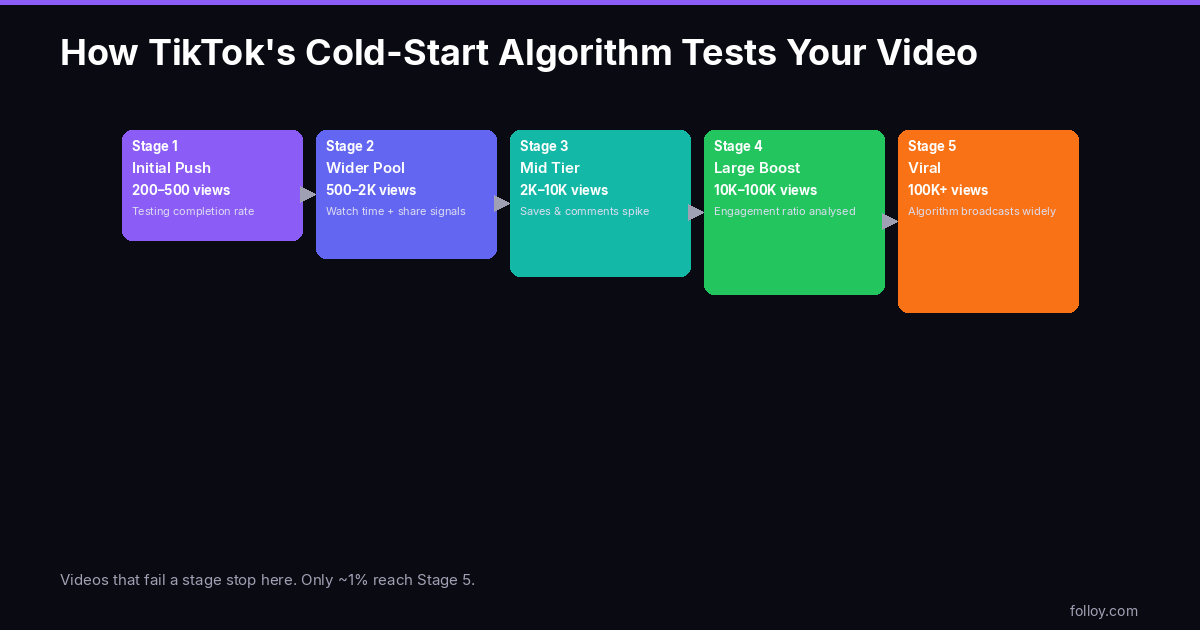
If those metrics clear an internal threshold, the video graduates to a larger pool, typically a few thousand viewers weighted toward people whose history matches the engaged sub-audience from cold-start. If it clears that threshold, it graduates again. Most videos top out at one or two graduations. The viral ones graduate four or five times and end up in front of millions.
One thing most guides skip over: the cold-start pool size is not the same for every creator or every region. TikTok allocates larger initial pools to accounts with a strong recent performance history, and to accounts in markets where TikTok has dense user data (primarily the US, UK, and parts of Southeast Asia). Creators in smaller markets like MENA or Eastern Europe typically start with a thinner cold-start pool, which means the early hours of a post are even more critical for breaking through.
What metrics actually matter
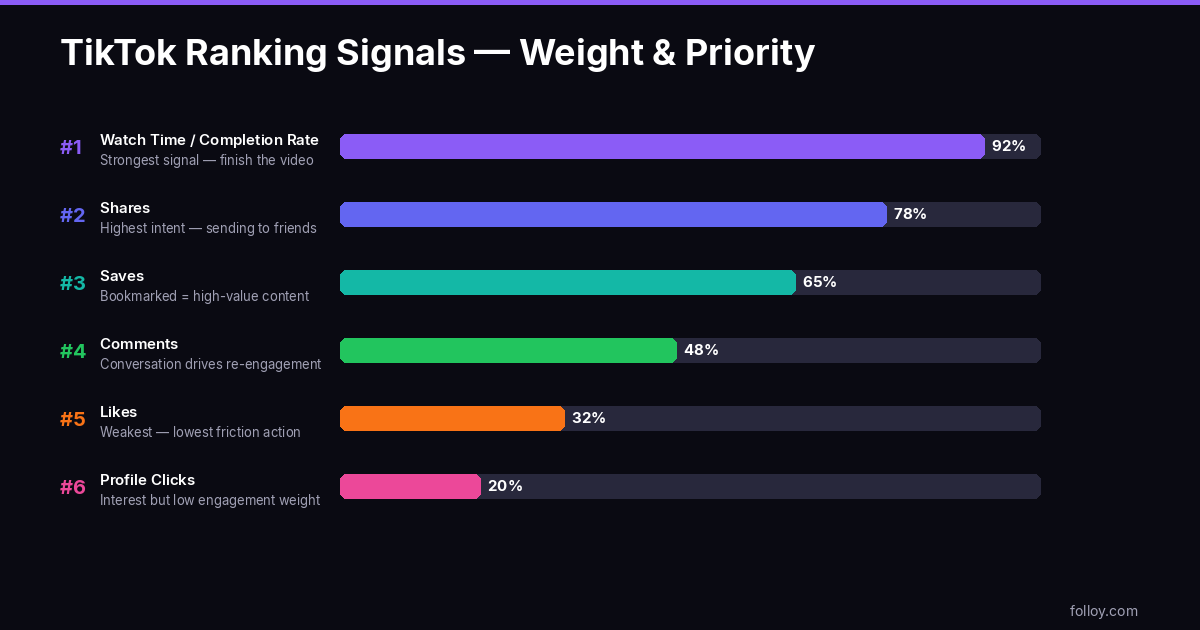
Internal documents leaked across 2022-2024, plus what creators have measured directly, point to a roughly stable hierarchy:
TikTok ranking signals: hierarchy and weight
| Signal | Relative weight | What drives it | Actionable fix |
|---|---|---|---|
| Watch-time ratio | Highest | % of video watched on average | Improve first 3 seconds; cut dead air |
| Shares | Very high | User shares to DMs or external apps | Create “send this to a friend” moments |
| Completions and replays | High | Full watches and rewatch loops | Create loop endings; short videos help |
| Comments | Medium-high | Meaningful text replies, not emoji-only | Ask a specific question in the video |
| Follows from view | Medium-high (rare but powerful) | Viewer follows after watching that video | End video with a compelling reason to follow |
| Saves | Medium | User bookmarks the video | Create reference content worth revisiting |
| Likes | Lowest of major signals | Heart taps | Don’t optimise for likes — optimise for watch time |
- Watch-time ratio: the percent of the video the average viewer watched. A 30-second video watched fully scores higher than a 60-second video watched halfway, even though both have 30 seconds of total watch time.
- Completions and replays: finishing the video signals the content delivered on its hook; replays signal the viewer wanted to look again. Both heavily favour short-form content (under 30 seconds) where completion is realistic.
- Shares: sharing to messages or off-platform is the strongest single signal because it indicates the viewer found the video useful enough to spend social capital recommending it.
- Comments: meaningful comments outweigh emoji reactions. Replying to your own comments is rumoured to extend reach because it triggers more engagement on the comments thread.
- Likes: the weakest of the major signals despite being the most visible. Likes correlate with reach but don’t drive it the way watch-time and shares do. If you want a small early-momentum nudge on a strong post, free TikTok likes can help prime the cold-start pump, but they won’t substitute for real watch-time.
- Follows from view: when a viewer follows you after watching the specific video, the algorithm treats that as the strongest possible quality signal, though it’s rare.
What’s overrated
- Hashtag stuffing. Three to five relevant hashtags help with the cold-start interest match. Twenty hashtags don’t help and can dilute the topical signal.
- Posting time. “Post at 7pm Tuesday” advice is mostly survivor bias; your cold-start pool is selected by interest, not time of day. The exception: if your content is news-adjacent or culturally tied to a moment, posting close to the moment helps.
- Trending sounds. Using a trending sound gives a small cold-start boost but only when paired with content that earns watch time on its own. A viral sound on a boring video flops anyway.
- Posting frequency. Two posts a day doesn’t beat one good post a day. Frequency only helps to the extent it gives you more shots at the cold-start lottery.
The hook is the entire game
Because watch-time ratio is the dominant signal, the first three seconds of your video determine almost everything. Cold-start viewers are skimming the FYP at high speed; if your first frame doesn’t earn another second, you’re done. The most-shared techniques among creators who consistently post over a million views:
- Pattern interrupt: open with motion, contrast, or an unfamiliar visual that breaks the pattern of whatever the viewer was just watching.
- Question-then-delay: ask a question whose answer comes later in the video. (“You wouldn’t believe what happens if you…”)
- Stake establishment: say in the first second what’s at risk. (“I bet $500 on this.”)
- Misdirection: start visually with something the audience expects, then pivot.
Length: shorter is back in fashion
TikTok pushed long-form (3-10 minute videos) hard in 2023 to compete with YouTube, but the FYP algorithm never really rewarded length. Creators who optimised for it saw watch-time ratios collapse. By late 2025 most successful creators were back to 15-35 second posts, treating long-form as a parallel format to be uploaded only when the content demanded it.
What changed in 2026 specifically
Compared to the 2024-2025 period, several ranking adjustments have become clear through creator testing and indirect signals from TikTok’s own policy announcements:
Greater weight on saves
In 2024 the save signal (bookmarking a video for later) was a secondary metric. By mid-2025, creators in niches like recipes, tutorials, and finance were reporting that high-save videos were getting dramatically more re-distribution days after the original post. The algorithm appears to treat a save as a “deferred share” signal, meaning the viewer values the content enough to return to it. This matters particularly for educational or instructional content where saves make intuitive sense.
Reduced keyword advantage for trending audio
In 2024, using the audio track of a trending video would place your video in the audio’s discovery shelf. By early 2026 that traffic source has shrunk considerably as TikTok’s recommendation engine has shifted more toward personalised interest matching and away from audio-based surfacing. Sound choice still matters for cultural fit, but the traffic boost from trending audio alone is now much smaller than it was 18 months ago.
Regional cold-start pool variation
TikTok has increasingly segmented its initial distribution pools by region. US-market videos now get a larger default cold-start pool than videos without location signals. Creators in the UK report slightly smaller default pools, while SEA (Southeast Asia) creators operating in competitive markets like Indonesia and Thailand see pools sized according to local engagement density. MENA creators often report the smallest cold-start pools but also report that when a video breaks out locally it can graduate very quickly to a global pool – so the on/off dynamic is sharper. Setting your account region correctly and producing content with clear geographic relevance helps the algorithm allocate you to the right initial pool.
| Region | Cold-start pool size | Graduation speed | Notes |
|---|---|---|---|
| United States | 500–2,000 users | Fast but highly competitive | Largest creator pool; hardest to break through |
| United Kingdom | 300–1,000 users | Medium | Creativity Program eligible; strong brand deal market |
| Southeast Asia | 200–800 users | Fast | Lower competition; local-language content dominates |
| MENA | 100–400 users | Very fast | Arabic content underserved; strongest growth window globally |
| Western Europe | 200–600 users | Medium-slow | GDPR friction; local-language outperforms English |
Caption length matters more
In 2023 most creators ignored captions. By 2026 creators in tutorial and knowledge-based niches have found that longer captions (200+ characters) with relevant keyword phrases are correlating with better cold-start topic matching. TikTok appears to be using caption text as a supplementary topical signal alongside visual and audio analysis.
The Creativity Program factor
TikTok’s Creativity Program (the replacement for the Creator Fund, rolled out through 2024) adds a layer of complexity that most algorithm guides don’t address. If you’re enrolled and producing monetisation-eligible content (videos over 1 minute, within approved niches), the algorithm’s behaviour toward your videos changes in a few ways.
Longer retention targets
For Creativity Program videos, TikTok’s own monetisation model benefits from longer watch sessions. There’s a credible case – based on testing by creators who produce both short and long content on the same account – that 60-120 second videos from Creativity Program accounts receive a mild boost in initial distribution compared to the same length from non-enrolled accounts. This makes sense: TikTok earns ad revenue from longer sessions, so surfacing monetisation-eligible content has a direct business incentive.
Niche restrictions matter more
Creativity Program content is subject to stricter topical filtering. Videos that touch on topics flagged as unsuitable for advertising – even tangentially – see reduced distribution regardless of engagement metrics. This is distinct from a community-guidelines violation. It’s an ad-suitability filter. If you’re enrolled in the Creativity Program and posting content in borderline niches (alcohol, firearms, strong political commentary), expect suppressed reach even on high-engagement videos.
The RPM feedback loop
Creators who track their RPM (revenue per thousand views) within the Creativity Program report that videos attracting higher-value ad placements tend to get more re-distribution in subsequent days. This creates a feedback loop where videos that happen to attract premium advertising end up with better organic reach. The practical implication: if you’re in the Creativity Program, posting content that attracts premium advertising categories (finance, travel, home improvement, software) may indirectly improve your algorithmic performance over time.
The “shadow ban” that probably isn’t
“My reach dropped from 50K average to 800, I’m shadow-banned” is one of the most common posts in creator forums. In almost every case the video metrics tell a different story: a string of low-watch-time posts that pushed the algorithm to deprioritise that creator’s recent content. There’s no specific “shadow ban” toggle for normal creators; what exists is a reach-decay curve based on recent performance, and it can be reversed by posting one strong-watch-time video.
Real shadow-bans (the technical term is “soft suspension”) do exist for accounts that violate community guidelines. They come with an in-app notification. If you didn’t get one, you’re probably not shadow-banned.
Recovering from a reach drop
If your recent videos have underperformed and your rolling average view count has fallen, there’s a concrete process that works better than guessing or waiting it out.
Step 1: diagnose the actual cause
Pull your last 20 videos in TikTok Analytics and sort by watch-time ratio. If the ratio has been declining across the board, your content is losing viewers early and the algorithm is responding logically. If the ratio is fine but views are low, the problem is cold-start categorisation – the algorithm is sending you to the wrong audience. If a specific video caused the drop (you can usually see a step-change in the graph), check whether that video had any community guideline flags or unusual engagement patterns.
Step 2: make one high-completion video
Don’t try to fix everything at once. Make one video specifically designed for a near-100% completion rate. That usually means 10-20 seconds, extremely clear hook in the first two seconds, a satisfying payoff at the end that requires watching all the way through. Something tutorial-like, a transformation, or a reveal works well. The goal isn’t to go viral – it’s to send a clear signal back to the algorithm that your recent content quality is good. Think of it as re-establishing your baseline.
Step 3: post consistently for two weeks without changing style
After posting the reset video, commit to your usual content style (not a different topic or format) for two weeks minimum. The algorithm’s recent-performance window is typically 14-21 days. Changing your content style mid-recovery confuses the topic categorisation and restarts the clock. If you want to give the reset video a small signal boost at the start, that is exactly the use case that free TikTok views were designed for – a nudge to early cold-start metrics, not a substitute for real engagement.
What we still don’t know
- The exact thresholds at each graduation step. They differ by topic vertical and creator history.
- How heavily ad-revenue contribution influences ranking on Creator Fund / Creativity Program videos at the margin.
- Whether the algorithm treats cross-app shares (TikTok to Reels, TikTok to YouTube Shorts) differently from in-app shares.
- How much the regional cold-start pool differences affect long-term account growth trajectories versus just individual video performance.
Practical takeaways
- Optimise the first three seconds harder than anything else.
- Default to 15-35 second content. Use longer formats only when warranted.
- Track watch-time ratio and shares per view in your analytics. Likes and follower growth are downstream.
- If reach drops, post one video targeting completions (short, visually clear, strong hook). Don’t change your content style based on a single bad week.
- Don’t hashtag-stuff. Three to five relevant hashtags are enough.
- If you’re in the Creativity Program, be aware that niche and ad-suitability affect reach independently from engagement quality.
- Saves are increasingly worth optimising for – particularly in educational niches where “bookmark this for later” is a natural viewer response.
Frequently asked questions
Does posting more often help TikTok reach?
Frequency gives you more shots at the cold-start lottery but doesn’t improve each video’s individual reach. If posting twice a day means lower-quality videos, one strong video a day will outperform two weaker ones. Quality over quantity is not a cliche here – it reflects how the watch-time-ratio signal actually works.
Why did one of my videos go viral but the next ten flopped?
Virality on TikTok is largely stochastic at the individual video level. A single video that graduates to a large pool often attracts a new audience that isn’t your usual viewer profile. Your next ten videos get measured against that inflated follower count, and most of the new followers don’t engage consistently. The account-level signal eventually normalises. This is not a penalty – it’s the algorithm correctly re-calibrating to your actual engaged audience.
Does the algorithm treat new accounts differently?
Yes. New accounts get a small “honeymoon” cold-start boost on their first few videos – TikTok needs data on what the account is about, so it distributes content a bit more broadly than it otherwise would. This is why some new creators get an unexpectedly strong first video, then see lower numbers on subsequent posts. It’s not that the algorithm switched against them; the honeymoon is simply over and the account is being judged on its earned history.
How do regions affect the TikTok algorithm?
US-market accounts generally get larger default cold-start pools than accounts in smaller markets. SEA and MENA creators typically see smaller initial pools but can break through to global distribution once a video clears regional thresholds. Setting your account region accurately and producing content with clear geographic or linguistic signals helps TikTok route your content to the right initial audience.
Do hashtags still matter in 2026?
They matter for initial topic categorisation but not for volume. Three to five specific hashtags that accurately describe your video’s topic help the algorithm place you correctly in cold-start. Beyond that, hashtag count doesn’t correlate with better reach. Over-tagging (20+ hashtags) can dilute the topical signal and slightly hurt categorisation accuracy.
What is the fastest way to recover from a TikTok reach drop?
The fastest recovery path is one short video under 20 seconds with a near-100% completion rate. Post it, don’t change your content style for two weeks, and let the algorithm’s recent-performance window update. Avoid deleting underperforming videos – deletion doesn’t help and removes whatever engagement data the video has. If you want to give the recovery video a small early signal, a modest boost to initial views can help with cold-start metrics, but the underlying content quality is what actually resets your trajectory.

What readers are saying
Real reactions from creators in the Folloy community.
Best plain-english explanation of the algo i’ve come across. The “small test batch first, then wider pushes” model finally explained why some of my videos sit at 200 views for a day then suddenly jump to 40k. I always thought that was a glitch.
the completion-rate-over-everything part is so important. i make my videos shorter now so people actually finish them and it made a measurable difference.
so rewatches really count that heavily? that explains why short loopable clips outperform my longer stuff every single time.
Yep — a rewatch is one of the strongest “this was worth it” signals you can send. Short, loopable, high-payoff clips stack those signals fast.
the bit about not deleting underperformers because they can revive later — i did NOT know that. saved a video from the trash bin and it picked up two weeks later. wild.