

Facebook growth tactics in 2026: build a massive organic following
Facebook is frequently declared “dead for organic reach,” and those who believe that are leaving enormous audiences uncaptured. In 2026, Facebook has 3.2 billion monthly active users, including the largest concentration of adults aged 25–55 of any social platform on earth. The algorithm has changed dramatically over the past three years, and the creators and brands who understand those changes are building followings faster than at any point since the early 2010s. This guide shows you how.
1. Understanding Facebook’s 2026 algorithm: the shift that changed everything
For years, Facebook’s algorithm was built around social connections, showing you content from friends, family, and Pages you followed. Starting in 2023, Meta began a major shift toward interest-based content discovery, much closer to TikTok’s model. Today, a significant portion of what you see in your Facebook Feed is from Pages and profiles you have never interacted with, served based on predicted interest signals.
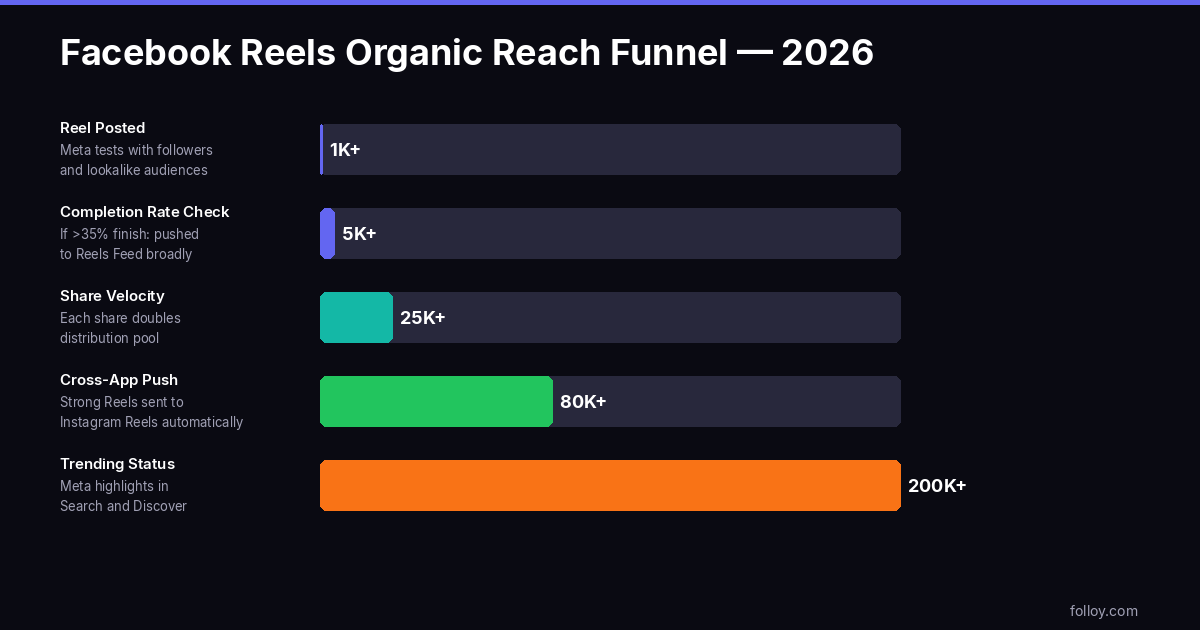
Organic reach is back, but it follows different rules now:
- Content must spark active engagement (comments, shares, saves); passive scrolling through your post signals low quality
- Reshares are the highest signal: when someone copies your post to their own timeline or a Group, Facebook treats that as a strong recommendation
- Video watch completion drives Reels distribution
- Comment depth matters more than comment count; a post with 10 long comments outperforms one with 50 emoji replies
2. The three growth channels on Facebook in 2026
Channel 1: Facebook Reels
Facebook Reels now have cross-app visibility; a Reel posted on Facebook can be recommended to Instagram users and vice versa. This makes Reels the fastest-growing reach channel on the platform. Post short-form vertical videos (15–90 seconds) using Facebook’s native Reels tool for maximum algorithmic distribution. To help early Reels gain traction, tools like Folloy’s free Facebook views can seed initial engagement signals.
Channel 2: Facebook Groups
Groups remain the highest-engagement surface on Facebook. A medium-sized, active niche Group (5,000–50,000 members) often drives more total engagement than a Page with 100,000 likes. Growing and participating in Groups is a cornerstone of Facebook growth strategy.
Channel 3: Facebook Page and follower system
The traditional Page system is alive, but the “Like” metric is less important than Followers. Users can follow a Page to receive updates without liking it. Build your follower count, which determines base distribution for non-video content.
3. Facebook Reels strategy: the fastest growth lever in 2026
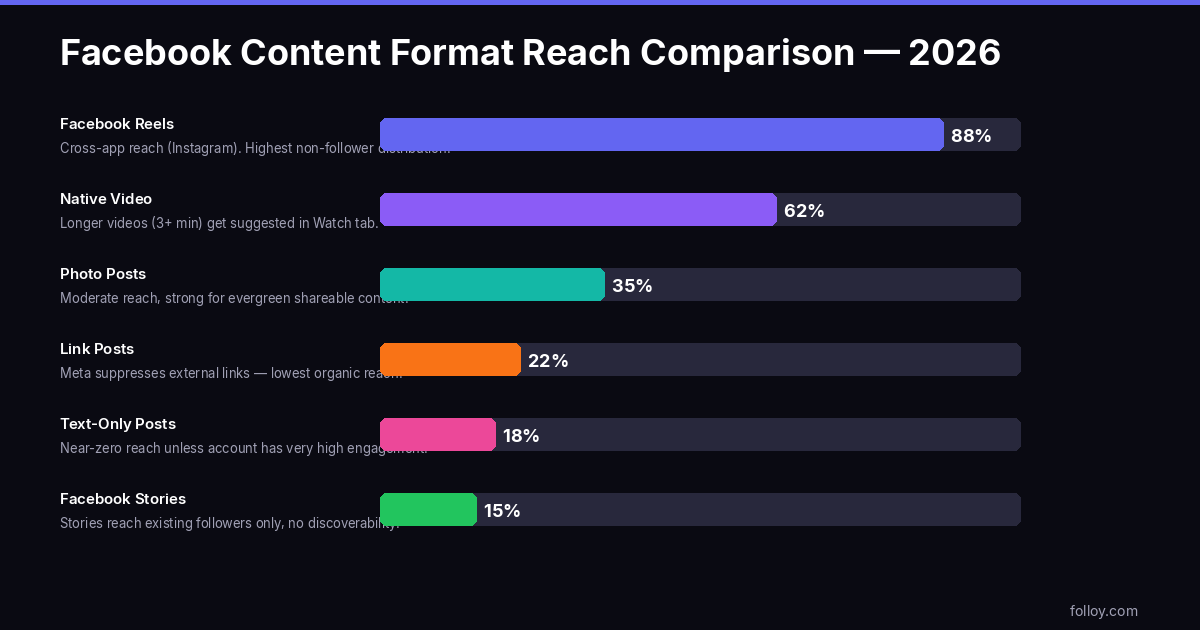
Facebook’s own data shows Reels drives 3x more reach to non-followers than any other content format on the platform. Here is how to get the most out of it:
What to post as Facebook Reels
- Educational quick tips in your niche (under 60 seconds)
- Relatable “this or that” and “real vs. expectation” formats
- Before-and-after transformations
- Trending audio-backed content (check Facebook’s Trending Audio tab)
- Reaction and commentary content on current news in your niche
Facebook content format reach comparison 2026
| Format | Non-follower reach | Engagement rate (avg) | Best use case |
|---|---|---|---|
| Facebook Reels | Highest (Reels tab + Explore) | 2–5% | Entertainment, quick tutorials, trend participation |
| Video posts (3+ min) | Medium | 1–3% | Storytelling, deep tutorials, vlogs |
| Group posts | High within Group members | 3–8% | Community discussion, advice, polls |
| Text + image posts | Low (mainly Page followers) | 0.5–1.5% | Announcements, quotes, conversation starters |
| Live video | Medium (gets notified to followers) | 5–10% | Q&A, events, product reveals |
Reels checklist
- First 3 seconds must stop the scroll, using a text hook plus visual movement
- Add captions (70%+ of Reels are watched without sound)
- Use Facebook’s native text, stickers, and music; external watermarks reduce distribution
- Keep Reels between 15–60 seconds for best completion rates
- Post 3–5 Reels per week for sustained distribution
4. Facebook Groups: the most underrated growth engine
Facebook Groups offer two powerful growth paths: creating your own Group, and strategically participating in existing ones.
Path A: create your own niche Group
A Facebook Group you own becomes an audience you control. Unlike Page followers, Group members receive notifications and see your posts in their Notifications tab, not just the algorithmic Feed. To build a Group:
- Name it around a high-search topic, not your brand name (e.g., “Meal Prep for Busy Parents” not “Jennifer’s Kitchen Community”)
- Set clear rules and a welcome post that establishes what makes this Group different
- Post a mix of prompts, polls, your own content, and genuine value; keep the tone communal, not broadcast
- Approve new members personally with a welcome mention, as new members who feel noticed tend to become active contributors
Path B: participate in existing Groups
Find the top 10 Facebook Groups in your niche (search “[your topic] tips”, “[your niche] community”, “[your niche] help”). Join them all. For 15 minutes per day, add genuinely helpful answers, share useful resources (not just your own content), and engage in ongoing discussions. Over time, your profile becomes a recognised voice, and curious Group members visit your Profile or Page and follow. This is slow but compounds over 2–3 months.
5. Post format strategy: what gets shared in 2026
Reshares are Facebook’s highest algorithmic signal. Write posts designed to be reshared:
High-share content formats
- Practical lists: “7 things every [audience] should know about [topic],” shared as reference material
- Perspective-challenging posts: “The reason [common belief] is completely wrong (and what to do instead),” which sparks debate and shares
- Emotional resonance posts: Nostalgic, heartwarming, or inspiring stories that people share to reflect how they see themselves
- Timely commentary: Relevant takes on trending topics in your niche; reshares spike when the topic is trending
- Definitive resource posts: “The complete guide to [topic] — save this.” Saves drive future algorithmic recommendations
6. Optimal posting frequency and timing
Consistency matters more than volume on Facebook. Over-posting dilutes your reach per post (Facebook limits how often any single Page or profile appears in any individual’s Feed).
Recommended schedule:
- Reels: 3–5 per week
- Text/image/link posts: 1–2 per day maximum
- Group posts (your own Group): 1 per day
- Group participation (other Groups): 5–10 comments per day
Best times to post (general baseline — verify against your own Page Insights):
- Wednesday and Thursday 1–4 PM
- Tuesday and Wednesday 9–11 AM
- Sunday 1–4 PM (high leisure browsing)
7. Facebook Live: real-time audience building
Facebook Live videos receive 6x more interactions than regular videos, according to Meta’s own platform data. Live streams are also stored as replays and keep accumulating views for weeks after broadcast. Topics that work well:
- Weekly Q&A sessions (“Ask me anything about [your niche]”)
- Real-time tutorials or demonstrations
- Behind-the-scenes processes
- Collaborative Lives with other creators in your niche for cross-audience exposure
Announce your Live at least 24 hours in advance with a post and the optional paid “Live Event” reminder feature. Even 50–100 viewers on a Live drives more algorithm momentum than a static post with the same reach.
8. Profile vs. Page: which should you use?
For personal brands and creators, your personal profile consistently outperforms a Page for organic reach in 2026. Posts from personal profiles are treated as more trusted, receive more engagement, and benefit from your real social graph. Use your Profile for personal brand growth; create a Page or Group for the community around your brand.
Switch your profile to “Follow” mode in Privacy settings, which lets strangers follow your public posts without needing to be friends. Combined with strategic posting, this turns your Profile into a growth engine alongside any Page you manage.
9. Facebook SEO: getting found in search
Facebook’s internal search handles over 2 billion queries per day. Many users search Facebook for topics, not people, so it is worth optimising for this:
- Include your primary keyword in your Page or Profile name where it fits naturally
- Write a detailed “About” section using the language your audience actually searches
- Use keyword-rich captions and descriptions; Facebook indexes text content from posts
- Post consistently about a single topic so Facebook’s content classification builds a strong topic association for your account
10. Cross-promote strategically to amplify reach
Cross-sharing your Facebook Reels to Instagram via the Meta Business Suite’s cross-post feature lets you reach both platforms’ audiences with a single piece of content. Share your Facebook content links in email newsletters, on Twitter/X, and in YouTube video descriptions to pull external traffic into Facebook’s ecosystem; external clicks signal demand and improve your Page ranking in Facebook search. Amplifying high-performing posts with free Facebook likes can also extend their organic reach window.
Frequently asked questions about Facebook growth
Is organic reach still possible on Facebook in 2026?
Yes — significantly, especially for Reels and Group content. Facebook’s shift toward interest-based recommendations means high-quality content can reach audiences it never could before. The strategy has changed; the opportunity is larger than ever for creators who adapt.
What type of posts get the most reach on Facebook?
Reels consistently receive the most reach to non-followers. Among static content, reshared posts and posts that generate long comment threads outperform likes-only posts by a factor of 3–5x.
How do I grow my Facebook Page organically?
Post Reels 3–5 times per week, create or participate actively in relevant Facebook Groups, and shift from broadcasting to community engagement. Invite engaged post commenters to follow your Page using the “Invite to Follow” feature under each post.
How many times a week should I post on Facebook?
3–5 Reels per week plus 1–2 text or image posts per day is a solid balance. Posting more than 3–4 times per day on a single account dilutes per-post reach.
Does Facebook still recommend Pages to new audiences in 2026?
Yes, but mostly through Reels, trending Group discussions, and “Pages You May Like” suggestions triggered by your content appearing in your followers’ Feeds. Prioritise Reels for discovery and Groups for community growth.

What readers are saying
Real reactions from creators in the Folloy community.
Everyone keeps writing Facebook off but for my local business it’s still where my customers actually are. The reels-on-facebook tip surprised me, i didn’t realise reach was that much higher there right now.
the group strategy section is spot on. built a community group around my niche and it drives more engagement than my actual page ever did.
honestly thought facebook was dead for under-30s but my engagement on reels there has been better than instagram lately. weird times.