

How to Get More Spotify Streams in 2026
Spotify hosts over 100 million tracks from more than 10 million artists. A small fraction of those artists account for the vast majority of streams. The difference between artists who break through and those who stay invisible is not exclusively talent or budget; it is understanding how Spotify’s recommendation systems work and how to use them deliberately. This guide covers every lever available to independent and emerging artists in 2026.
1. How Spotify’s discovery algorithm works in 2026
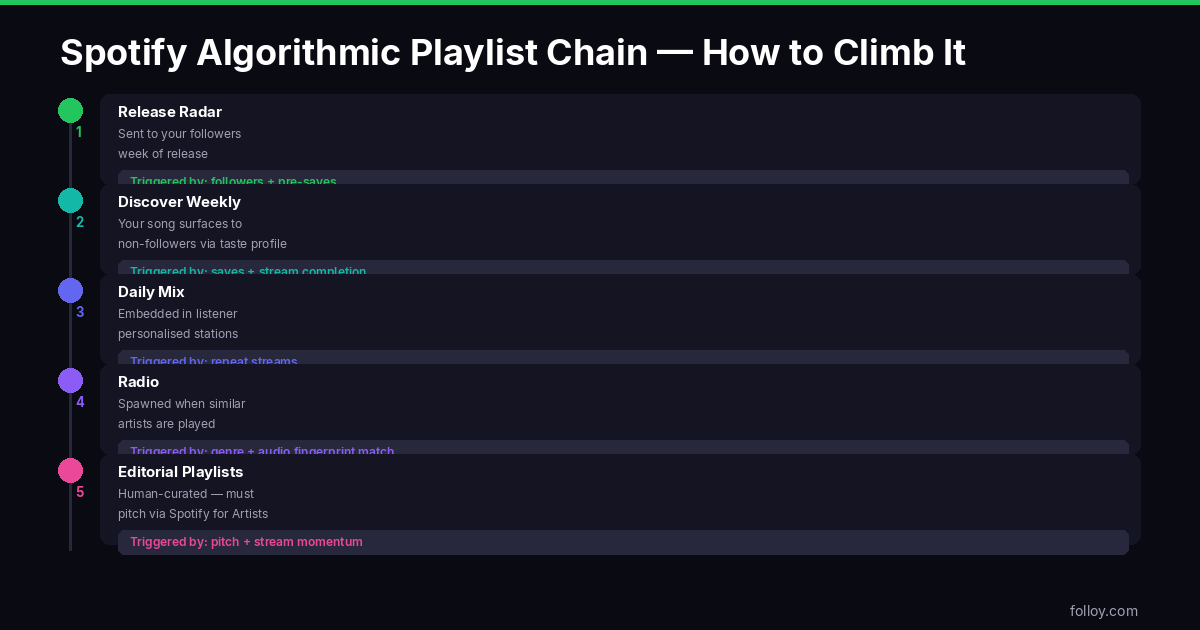
Spotify uses multiple interlocking systems to recommend music. Understanding each one helps you decide where to focus your promotional energy.
Spotify taste profile
For each listener, Spotify builds a taste graph based on listening history, saves, playlist adds, skips, and the listening patterns of other users with similar tastes. Your song gets recommended when it statistically resembles music a given listener already loves, measured by audio features and co-listening patterns.
Algorithmic playlists
These are Spotify’s most powerful discovery tools, generated uniquely for every listener:
- Discover Weekly: 30 songs curated every Monday based on collaborative filtering
- Release Radar: New releases from artists a listener follows or has engaged with
- Daily Mixes: Recurring playlists blending a listener’s favourites with similar discoveries
- Radio: Artist or song-based radio that introduces similar music
Getting into these playlists is the most scalable organic growth lever on Spotify. It is driven primarily by save rate, completion rate, and playlist-add behaviour from real listeners. Seeding your initial plays with a tool like Folloy’s free Spotify plays can help establish the listening signals Spotify needs to start recommending your music.
Editorial playlists
Human-curated by Spotify’s editorial team. A single placement can deliver millions of streams. They are pitch-driven, competitive, and require advance notice, but independent artists do land them with the right approach.
2. The metrics that actually matter
Not all streaming activity carries the same weight. Spotify relies on these signals most heavily when deciding whether to push your music further:
- Save rate: The percentage of listeners who save your song to their library. A save is the strongest intent signal Spotify has: it means a listener wants to hear you again. Industry benchmark: 4%+ save rate indicates a song the algorithm will push.
- Completion rate: What percentage of listeners finish the song without skipping. A skip before 30 seconds tells Spotify the song is a poor match for that listener, and high skip rates suppress further recommendations.
- Playlist add rate: When listeners add your song to their own playlists, Spotify uses that track’s audio fingerprint to find more of your music for similar listeners.
- Follow triggers: When someone follows your Artist Profile after hearing a song, Spotify scores that song very positively.
- Listener-to-stream ratio: A high ratio (many streams per listener) indicates repeated listening, which Spotify treats as a quality marker.
3. Artist profile: your Spotify storefront
Your Artist Profile is the first destination for any listener who wants to explore beyond a single song. It needs to be complete before you start driving traffic to it.
- Verified profile: Claim and verify your Spotify for Artists profile at artists.spotify.com. This gives you control over your profile, access to analytics, and the ability to pitch to editorial playlists.
- Artist photo: Professional, high-contrast, consistent with your visual identity across all platforms.
- Artist bio: Written in third person, 150–300 words. Include your genre, notable achievements (even smaller ones like regional recognition or press features), and the emotional or thematic identity of your music. Update it with each major release.
- Featured playlist: Create an Artist Pick, a playlist pinned to the top of your profile. Use it to feature your latest release, a mood-based playlist, or songs that influenced your album.
- Canvas: Add looping visual art to your tracks via Canvas (8–9 second looping video). Tracks with Canvas see 145% higher saves on average, per Spotify’s own data.
- Lyrics: Make sure your lyrics are synced via Spotify for Artists or a distributor that supports Musixmatch sync. Listeners who engage with lyrics spend more time in the app with your song, which signals deeper engagement.
4. Release strategy: launching a song for maximum algorithmic impact
The launch window of a new release matters more than most artists realise. Spotify evaluates early engagement signals in the first 48–72 hours to decide whether to push a track to algorithmic playlists. A concentrated burst of real engagement in that window is worth more than the same volume spread over a month.
The pre-release playbook
- Submit to Spotify Editorial 7+ days before release: Use Spotify for Artists’ pitch tool. You get one pitch per release. Write a compelling pitch that describes the song’s mood, intended audience, and story. Include any notable press or collaborators.
- Run a pre-save campaign: Tools like Hypeddit, DistroKid’s HyperFollow, or Toneden let fans pre-save your song. Pre-saves convert to saves and playlist adds the moment the song goes live, front-loading your engagement signals.
- Announce across all platforms 1–2 weeks early: TikTok snippet, Instagram Reel teaser, YouTube Shorts preview. Build anticipation before release day.
- Plan your release day posts: Day-of posts on TikTok, Instagram, Twitter/X, Facebook, and email newsletter, all linking directly to the Spotify track.
Release day execution
- Post on all social platforms within the first 2 hours of release (6 AM local time works well for most artists)
- Share the Spotify link directly, not a distributor link, to drive traffic straight to Spotify
- Ask fans to save, not just stream: “Hit Save so Spotify knows to add it to your Discover Weekly”
- Share to your own Instagram and Facebook Stories
5. Playlist pitching: getting on third-party playlists
Beyond Spotify’s editorial playlists, thousands of independent playlist curators collectively control audiences of millions of listeners. Placements across multiple smaller playlists can deliver the stream count needed to trigger algorithmic momentum.
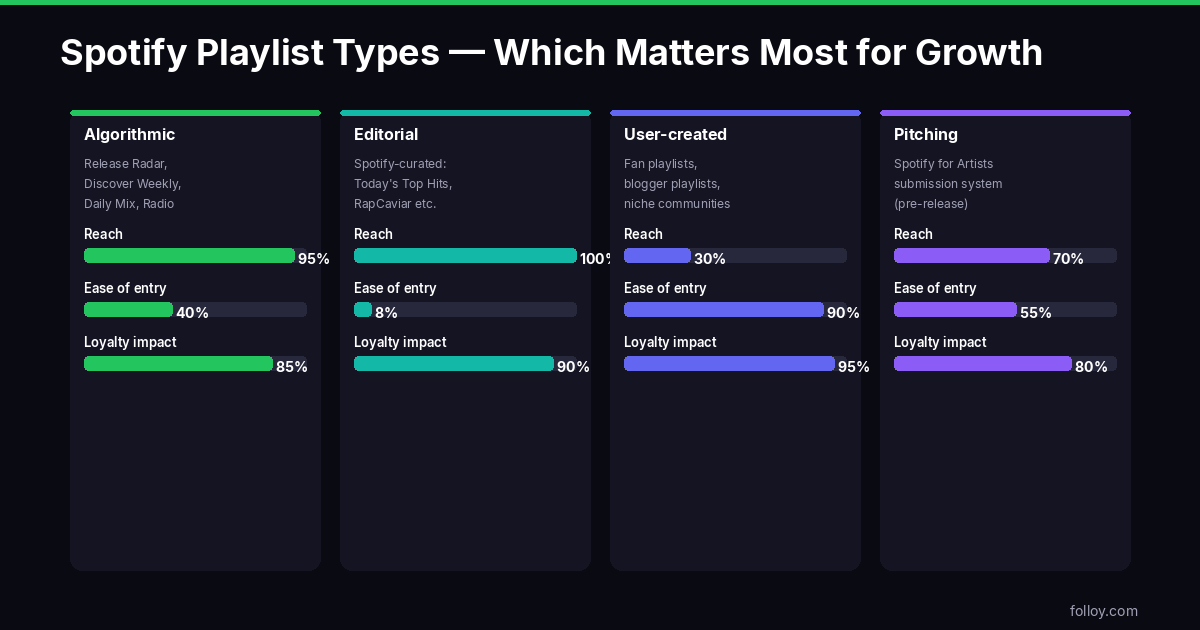
Spotify playlist types: what each one means for growth
| Playlist type | How to get featured | Reach potential | Sustains long-term? |
|---|---|---|---|
| Editorial (Spotify curated) | Pitch via Spotify for Artists 7+ days pre-release | Very high (millions) | Yes — drives algorithmic chain |
| Algorithmic (Discover Weekly, Release Radar) | Earn via save rate + completion rate from real listeners | High (personalised per user) | Yes — refreshes weekly |
| Listener-curated (independent) | Pitch via SubmitHub, Groover, or direct contact | Low–Medium | Varies by playlist size and activity |
| Artist-collaborative playlists | Direct collab with another artist | Medium (cross-audience) | Depends on both artists’ activity |
| Brand/media playlists | Outreach to brands, publications, influencers | Medium–High | Sometimes — depends on playlist update frequency |
How to find and pitch independent curators
- Search Spotify for playlists in your genre (e.g., “indie folk 2026”, “lo-fi hip hop chill”). Filter for playlists with 1,000–50,000 followers, large enough to matter but small enough that your pitch won’t be ignored.
- Find the curator’s contact information; many link to Instagram or an email in the playlist description. Tools like Soundplate, PlaylistPush, and SubmitHub aggregate curator contacts and streamline outreach.
- Write a personalised pitch in 2–3 sentences: why does this song fit this specific playlist, and what makes it different? Attach a Spotify link, not a download link.
- Follow up once after 5–7 days if you hear nothing. Do not keep emailing.
6. Using short-form video to drive Spotify streams
TikTok, Instagram Reels, and YouTube Shorts are the most powerful external drivers of Spotify stream spikes in 2026. A song that catches on TikTok can generate hundreds of thousands of streams in days. But you do not need a viral moment to see results; consistent short-form video creates a steady, ongoing stream flow.
Formats that drive streaming behaviour:
- Behind-the-scenes of songwriting or production, as curiosity about the finished product drives streams
- “The meaning behind the lyrics” content, which drives engagement and save rate at the same time
- Performance clips with genuine emotion; even low-production acoustic clips work well
- Using your song as background audio for trend-adjacent TikTok content
- Reaction hooks: “I wrote this at 2 AM after [relatable experience] — here’s how it turned out”
7. Building a true fan base: the 1,000 true fan strategy
One of the more durable ideas in music: 1,000 fans who stream your music 10 times a month generate more reliable growth than 100,000 casual one-time listeners. Build community alongside distribution. Growing your free Spotify followers count is one early step that helps your new releases land in fans’ Release Radar automatically.
- Start an email list; it is platform-independent and converts at far higher rates than social followers
- Build a Discord server for your most dedicated fans, who drive word-of-mouth streams
- Host listening parties for new releases with your core community before the public launch
- Reply personally to every comment on your social posts during the first 48 hours of a release; fans who get a reply become evangelists
8. Collaboration strategy: the fastest path to new listeners
Collaborations expose you to established audiences who have already demonstrated they like music in your genre. Every genuine collab can meaningfully expand your listener base.
- Work with artists whose Spotify Monthly Listener counts are 2–5× yours
- Make sure the collaboration appears on both artists’ profiles, so both audiences get the Release Radar notification
- Remix exchanges: release each other’s songs as official remixes; both versions live on both profiles
Frequently asked questions about Spotify growth
How do you get on Spotify Discover Weekly?
Discover Weekly is triggered when your song has a strong save rate and completion rate from real listeners, and when collaborative filtering identifies your song as a close match for a listener’s taste profile. A pre-save campaign and an engaged fanbase launch delivers the signals Spotify needs to include you.
How many streams do you need to start making money on Spotify?
Spotify pays approximately $0.003–$0.005 per stream (net to rights holders). To earn $1,000/month, you need roughly 200,000–300,000 monthly streams. Royalties are split between the artist and distributor per your agreement.
How do I pitch to Spotify editorial playlists?
Submit via Spotify for Artists at least 7 days before release. You must have music scheduled via a distributor (DistroKid, TuneCore, CD Baby, etc.). You can only pitch one song per release at a time. Write a specific, honest pitch about the mood and audience; editors see thousands of pitches and respond to specificity over hype.
Does Canvas really help Spotify growth?
Yes — Spotify’s internal data shows tracks with Canvas receive 145% more saves and 20% more streams on average. It is free to add via Spotify for Artists and takes minutes to upload.
How long does it take to grow on Spotify organically?
For independent artists releasing consistently (4–6 releases per year), algorithmic playlist placements and steady growth typically become noticeable after 12–18 months of deliberate strategy. Viral moments can accelerate this, but sustainable Spotify growth is built on consistent releases and listeners who come back.

What readers are saying
Real reactions from creators in the Folloy community.
The playlist pitching timeline (7 days before release) is the single most useful thing i’ve read this year. Submitted early for my last single and actually landed an editorial add for the first time.
as a small artist this was really encouraging. the part about pre-saves feeding the algorithm on day one makes so much sense, i never took those seriously before.
good stuff. how long did it take you to see traction from the canvas + clip strategy? i added canvases to my whole catalog but it’s been kinda slow.
Hey Marcus — canvases mostly help save-rate and shares rather than raw discovery, so it’s a slow compounding effect. Pair it with the playlist + pre-save timing in the post and you’ll feel it more.
saving this for my next drop. the bit about not buying fake streams was a good warning — a friend got her track flagged and pulled, scary stuff.
real talk the release-radar tip alone is worth the read. consistency every 4-6 weeks kept me in rotation way longer than dropping a big album once a year.