

How to Grow on TikTok in 2026: The Organic Growth Playbook
TikTok now has over 1.9 billion active users, yet most creators upload videos that get fewer than 300 views. The gap between creators who explode and those who stagnate is rarely talent. It’s almost always strategy. This guide breaks down exactly how the TikTok algorithm works in 2026, which growth tactics are delivering results right now, and the steps you need to go from zero to your first 10,000 followers.
1. Understand how the TikTok algorithm actually works in 2026
The For You Page (FYP) is TikTok’s core recommendation engine, and understanding it is the foundation of every growth tactic that follows. TikTok does not primarily show your content to your existing followers. It distributes it to strangers based on predicted engagement probability.
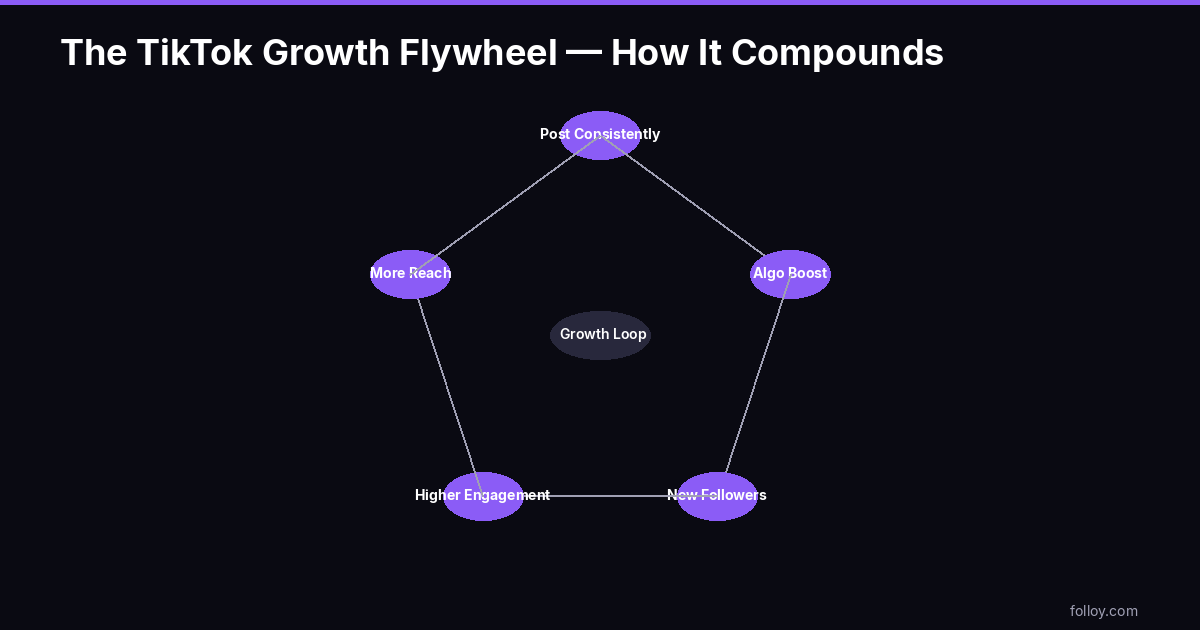
When you post a video, TikTok serves it to a small test cohort (typically a few hundred users). It then measures:
- Watch time and loop rate: Did people watch the whole video? Did they rewatch it?
- Engagement rate: Likes, comments, shares, and saves relative to views. Boosting this early with free TikTok likes can strengthen your initial engagement signal.
- Re-shares and stitches: Content spread by other users signals virality.
- Follows post-view: If someone followed you after watching, TikTok scores the video very highly.
- Profile clicks: Visits to your profile from the video indicate strong interest.
If your video passes the first test cohort with strong signals, TikTok expands distribution, first to thousands, then tens of thousands, and potentially millions. This is why a single great video from a brand-new account can rack up 500,000 views while a three-year-old account with 50,000 followers gets mediocre reach on a lazy post. Every video is a fresh opportunity regardless of your follower count. Optimise for watch time above everything else. Tools like Folloy’s free TikTok views service can help new accounts build that initial momentum signal during the cold-start phase.
2. Nail your niche before you post a single video
The most common reason creators fail to grow is posting content that’s too broad. The TikTok algorithm learns what your account is about and serves it to the right audience. If your last 10 videos cover cooking, travel, pets, finance, and comedy, TikTok can’t build a reliable interest graph for you — and neither can potential followers.
Follow this framework to define your niche:
- Intersection test: Write down three things you know well and three things you could talk about daily without burning out. Your niche lives at the intersection.
- Audience demand check: Search your topic on TikTok. Are there videos with 100,000+ views? That means demand exists. Can you make those videos better or from a different angle?
- Competition audit: If there are already 50 massive accounts doing the same thing identically, find a sub-niche. “Personal finance” is saturated. “Personal finance for nurses in their 30s” is not.
- Sustainability check: Can you make 50 videos on this topic without running dry? If not, it’s too narrow.
Once you have a niche, stick to it for at least 30 consecutive posts before evaluating. Consistency signals to the algorithm what your account represents.
3. Master the hook — the first 1–3 seconds decide everything
Your hook is the first frame, first spoken word, and first caption line. TikTok users scroll fast. If your opening doesn’t create an immediate reason to stop, your video is dead before it begins.
Hook structures that work in 2026
- Curiosity gap: “I tried this TikTok hack every day for 30 days. Here’s what actually happened.”
- Bold claim: “This one setting doubles your TikTok reach and 99% of creators ignore it.”
- Relatable pain point: “If you’re posting every day and still getting 200 views, watch this.”
- Visual shock: Start mid-action. Show the end result first, then explain how you got there.
- Direct address: “POV: You’re a developer who just discovered TikTok ads actually work.”
Test at least three different hook styles across your first 15 videos and check which produced the highest average watch percentage. You can find this in your TikTok analytics under “Average Watch Time.”
4. Post length: short vs. long videos in 2026
TikTok now supports videos up to 10 minutes, but length should always serve the content. Never pad for the sake of it. Here’s the length guidance that holds up in practice:
- 7–15 seconds: Best for relatable moments, quick tips, and trend participation. Extremely high loop rate potential.
- 30–60 seconds: The sweet spot for educational and storytelling content. Long enough to deliver value, short enough to hold attention.
- 2–3 minutes: Works for story time content, tutorials, and controversial topics that need context.
- 5–10 minutes: Only if you’ve already proven strong retention on shorter videos. TikTok pushes long-form harder to creators who’ve demonstrated they can hold an audience.
Watch time percentage matters more than absolute seconds watched. A 15-second video with 95% average watch time will beat a 3-minute video with 30% every time.
5. Hashtag strategy that actually drives discovery
The old advice of stuffing 20 niche hashtags is outdated. In 2026, TikTok’s AI reads your caption, audio, and on-screen text to determine topic. Hashtags are a secondary signal. That said, a smart approach still matters.
A tiered method that works:
- 1 broad hashtag (e.g., #TikTokTips), signalling the category
- 2 mid-size hashtags (100M–1B views), covering your core topic
- 2 niche hashtags (under 50M views), for specific community targeting
Avoid hashtags with trillions of views (#fyp, #viral, #foryoupage). Your video drowns immediately. Look for hashtags where content posted 24 hours ago is still appearing. That indicates lower competition and active crawling.
6. Posting schedule and frequency
Consistency beats virality chasing. Creators who post one video per day for 90 days virtually always outperform creators who post three videos in one week and disappear for two weeks.
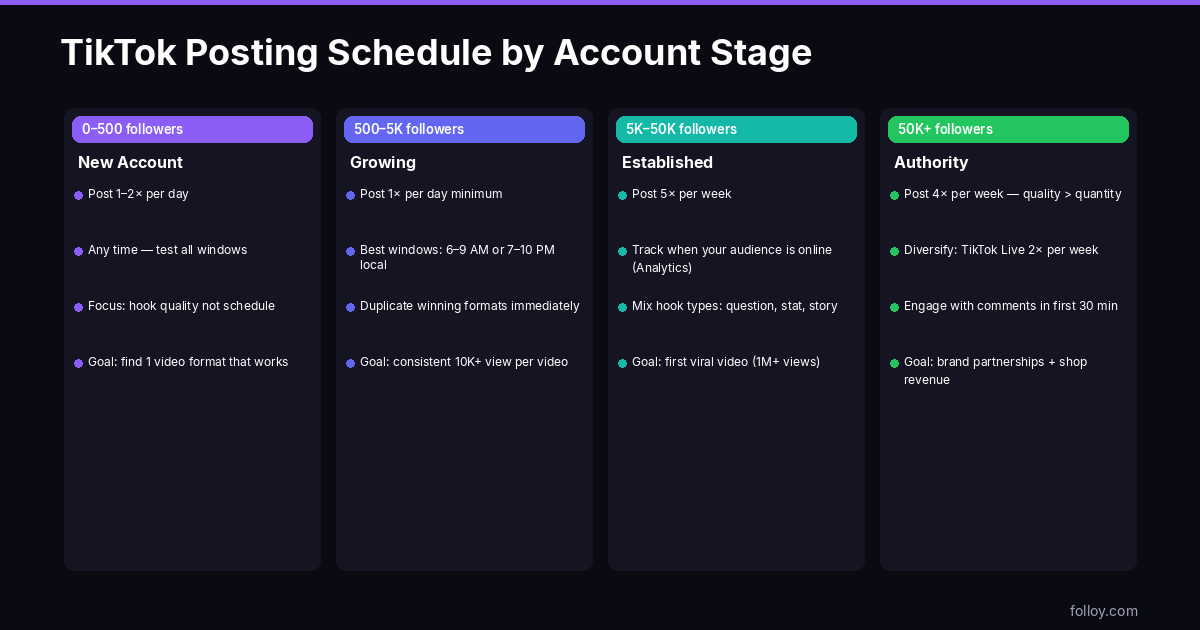
A realistic starting schedule:
- Minimum: 1 video per day
- Ideal: 1–2 videos per day
- Upper limit: 3–4 per day. Beyond this, quality suffers and TikTok may throttle your account.
As for timing, post when your target audience is most active. Your TikTok analytics (available after your first 100 followers) show your audience’s most active hours. As a general starting point, 6–9 AM, 12–3 PM, and 7–10 PM in your target audience’s timezone have historically produced the best reach.
Recommended TikTok posting schedule by account stage
| Account stage | Daily posts | Optimal times (audience timezone) | Focus |
|---|---|---|---|
| 0–1K followers | 1–2 | 6–9 AM, 7–10 PM | Hook testing — try 3+ hook formats |
| 1K–10K followers | 1–2 | Based on Creator Tools analytics | Double down on top-performing formats |
| 10K–100K followers | 1–3 | Your analytics active hours | Series content + collabs + trending audio |
| 100K+ followers | 1–2 (quality over volume) | Your analytics active hours | Community depth + long-form experiments |
7. Use trends — but with your niche’s angle
Trend participation accelerates reach because TikTok actively pushes trending sounds and formats to broader audiences. The mistake most creators make is copying a trend identically, which just dilutes the original. Apply the trend format to your specific niche instead.
If the current trend is a “Hot vs. Not” format, don’t do the generic version. Do it for your niche: “Hot vs. Not: Personal Finance Habits of People Who Hit $100k in Savings Before 30.” You ride the algorithm tailwind while standing out in your category.
8. Optimise your profile for conversion
Every viewer who visits your profile after watching a video is a potential follower. Your profile has to convert them. Audit these elements:
- Profile photo: High-contrast, face-forward, smiling if personal brand. Clear logo if brand account.
- Username: Simple, memorable, searchable. Include your niche keyword if possible (e.g., @budgetwithjamie).
- Bio: Three lines. Line 1: Who you help. Line 2: What you help them achieve. Line 3: Call to action (Follow for daily tips / Link in bio).
- Pinned videos: Pin your best-performing or most representative videos. These are the first impression for new visitors.
9. Engage strategically to accelerate the algorithm
TikTok rewards accounts that spend time on the platform. Creators who engage with comments, reply with video responses, and comment on other creators’ videos in their niche see measurably better distribution. In practice, this means:
- Reply to every comment in the first 60 minutes after posting; this spikes engagement signals
- Post video replies to the most interesting comments, which become new videos with built-in context
- Comment meaningfully (not emoji-spam) on 10–15 videos per day in your niche. TikTok’s reply comment system will surface you to audiences of those creators
10. Cross-promote without burning out
Share your TikToks to Instagram Reels and YouTube Shorts, but remove the TikTok watermark first. Use SnapTik or TikTok’s own “Save Video” without effects. Instagram and YouTube deprioritise content carrying a competitor’s watermark.
Cross-promotion creates a compounding effect: a viewer on Instagram discovers your TikTok, follows there, and both platforms now serve your content to a wider audience pool.
11. Use TikTok series and playlists
TikTok’s Series feature (behind a paywall for creators) and Playlists (free) let you group related content. When a viewer watches video 1 of a series and clicks to video 2, session watch time skyrockets, a signal TikTok values enormously. Build series around recurring formats: “Week in the life,” “30-day challenge,” or “Ask me anything every Monday.”
12. Analytics-driven iteration: the compounding growth loop
Top creators review their analytics weekly and ask three questions:
- Which videos had the highest average watch percentage? Why? (Hook? Topic? Format?)
- Which videos had the highest follower conversion rate? What made them shareable? (If you want to accelerate your initial count, Folloy also offers free TikTok followers to help seed early social proof.)
- Where exactly do viewers drop off? The analytics timeline shows this. Fix the problem zone.
Make more of what works. Cut what doesn’t. This loop (post, measure, adjust) is what separates creators who break 100,000 followers from those who plateau at 2,000. I keep seeing creators skip this step and wonder why nothing changes.
Frequently asked questions about TikTok growth
How long does it take to grow on TikTok organically?
Most creators posting consistently (one video per day) in a defined niche reach their first 1,000 followers within 30–60 days. The 10,000 follower milestone typically takes 3–6 months of consistent, data-driven posting.
Does posting time really matter on TikTok?
It matters more in the early stages before your account has strong audience data. As your account grows, TikTok serves your content when your specific followers are active, which you can see in Creator Tools analytics.
How many hashtags should I use on TikTok?
3–5 hashtags is the current best practice. Specificity matters more than volume. Two niche hashtags outperform 10 generic ones.
Why is my TikTok account stuck at the same views?
This usually means low watch time percentage. Review your first 3 seconds. Strengthen the hook, cut dead air, and test different opening formats until retention improves past 50%.
Can I grow on TikTok without showing my face?
Yes. Faceless accounts in niches like finance, coding tutorials, nature, and cooking regularly build audiences of hundreds of thousands. A strong on-screen text hook and engaging visuals matter far more than showing your face.
What readers are saying
Real reactions from creators in the Folloy community.
The watch-time-over-followers framing is the whole game and most people miss it. I have a video with 800k views from when i had 200 followers. The algo genuinely does not care how big you are, only whether people finish the video.
needed the reminder about posting times mattering less than i thought. i stressed over the “best time” for months and honestly just posting consistently did way more.
the niche-down advice keeps coming up everywhere and now i finally get why. my broad account flatlined, started a focused one and it took off in weeks.
Love hearing that, Felix. Focused accounts give the algorithm a clear audience to test against — that’s why they tend to find their people faster. Keep going!
saving this. the trend-but-make-it-yours section is the bit i always get wrong, i just copy trends exactly and they flop. gonna try adding my own spin.