

How to Grow a YouTube Channel in 2026
YouTube has 2.7 billion logged-in monthly users and is the world’s second-largest search engine. Yet 90% of YouTube channels never reach 1,000 subscribers, not because of a lack of content, but because of a lack of strategy. The creators who grow consistently in 2026 understand how YouTube’s search engine, its recommendation algorithm, and short-form content all interact. This guide covers every dimension of that strategy.
1. YouTube’s dual discovery system: search and recommendations
Unlike TikTok or Instagram, which are almost entirely recommendation-driven, YouTube runs two powerful and independent discovery channels at the same time. They require different optimisation strategies, and most creators only think about one of them.
YouTube search (SEO-driven)
YouTube is a search engine. Hundreds of millions of people search it daily for tutorials, reviews, explainers, how-tos, and entertainment. Ranking in YouTube search results delivers long-tail organic traffic that compounds for years; a well-optimised video from three years ago can still be your top traffic source today.
YouTube recommendations (algorithm-driven)
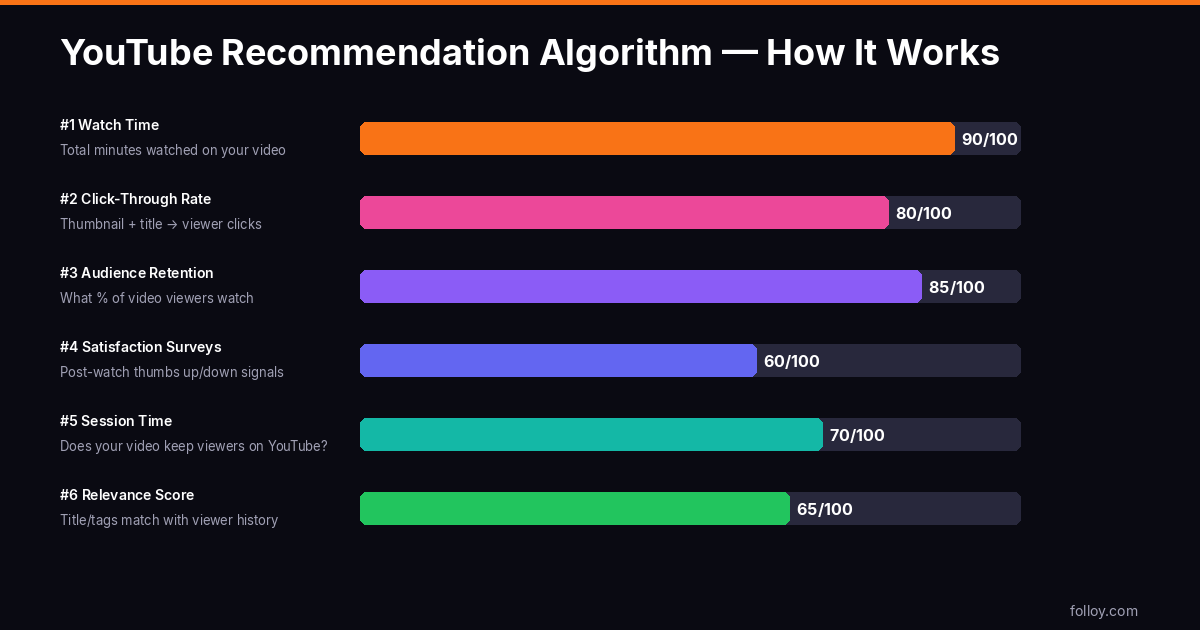
The suggested video sidebar, home page, and “Up Next” queue are all powered by YouTube’s recommendation AI. This system matches videos to viewer interest profiles based on watch history, watch time, click-through rates, and session time contribution.
Getting into recommendations is what causes channels to grow quickly, putting your content in front of viewers who are already in a watching mindset but have never heard of you. High click-through rate (CTR) plus high average view duration (AVD) is the primary formula for recommendation system pickup. Tools like Folloy’s free YouTube views can help new videos accumulate the early watch signals that trigger algorithmic recommendation.
2. Niche definition: the foundation before a single upload
The most common reason YouTube channels stall is being too broad. YouTube’s recommendation algorithm builds a content identity for every channel, learning “this channel is about X and Y audiences love it.” If your channel posts cooking tutorials one week, travel vlogs the next, and gaming reviews after that, YouTube cannot build that identity, and the algorithm will not recommend your content to any consistent audience.
How to choose your YouTube niche
- Search demand test: Search your topic on YouTube. Do videos with strong view counts appear? Are they from the last 12–24 months? Both are good signs of active demand.
- Competition gap analysis: Are all the top results from channels with millions of subscribers? Find a sub-niche where 50k–500k subscriber channels dominate. You can compete there.
- Sustainability test: Can you produce 50 videos on this topic without running dry? If not, it’s too narrow. If you’re not interested in it past 50 ideas, it’s the wrong fit.
3. YouTube SEO: how to rank in search
YouTube SEO determines whether your videos surface when people search for topics you cover. It is one of the most powerful long-term growth levers available to any creator, and most people underuse it.
Keyword research for YouTube
Start with YouTube Search Autocomplete: type your topic into the search bar and note every autocomplete suggestion. These are real queries people are typing. Tools like TubeBuddy, VidIQ, and Google’s own Keyword Planner extend this research with search volume and competition data.
Target keywords that balance reasonable search volume with lower competition. Avoid going head-to-head with channels that have 1M+ subscribers on their most-viewed topics. Find the gaps they left.
Where to place keywords
- Title: Include your primary keyword as early in the title as possible
- Description: Write a 200–300 word description. The first 2–3 sentences should be keyword-rich since they appear in search results. Include secondary keywords naturally throughout.
- Tags: Add 8–12 tags: your primary keyword, exact-match variations, related terms, and your channel name
- File name: Name your video file “your-keyword-here.mp4” before uploading; YouTube reads the file metadata
- Chapters: Add timestamps with keyword-rich chapter titles; they show up in Google search results and drive clicks
- Subtitles/Captions: Upload an accurate transcript or let YouTube auto-caption. YouTube indexes captions for search relevance.
4. Thumbnails: the single biggest driver of channel growth
Your thumbnail is the first impression your video makes in search results, recommended feeds, and home pages. YouTube’s own data shows that thumbnail CTR is one of the strongest signals the recommendation algorithm uses to decide which videos to push. A compelling thumbnail can double your views on the same video; a weak one will halve them.
The high-CTR thumbnail formula
- High contrast: Bright backgrounds (yellow, orange, cyan) with a clearly legible foreground subject
- Face with emotion: Videos with an expressive human face in the thumbnail consistently outperform faceless thumbnails in most niches. The expression should match the video’s emotional tone.
- 3 words maximum: Text on thumbnails should be 1–3 words, large font, readable at mobile thumbnail size
- Curiosity gap: The thumbnail and title together should create a question the viewer wants answered (“I tried this for 30 days” + thumbnail of shocked face)
- Brand consistency: Use a consistent colour palette, font, and style across thumbnails so your videos are immediately recognisable in browse features
5. Video structure for maximum watch time
Average View Duration (AVD) and percentage of video watched are the most important on-video metrics. YouTube rewards content that keeps people watching, both for longer session times and as a signal of quality for recommendation purposes.
Optimal video structure
- Hook (first 30 seconds): State immediately what they will learn or get from watching. Show the end result. Do not start with a 2-minute intro or channel welcome, which is where most drop-offs happen.
- Pattern interrupts: Every 90–120 seconds, change something: a cut, a graphic, a new environment, a sound effect. This resets viewer attention and reduces the chance of them leaving.
- Open loops: Tease what is coming later in the video early on (“and at minute 12, I’ll show you the trick that made all the difference”). This creates a reason to keep watching.
- Value density: Every minute should deliver something useful, entertaining, or genuinely interesting. Cut anything that doesn’t serve the viewer.
- End screen CTA: Last 20 seconds: ask for a subscription and recommend another video. Keep it brief; most viewers who stay to the end are already ready to subscribe.
6. YouTube Shorts: the 2026 channel accelerator
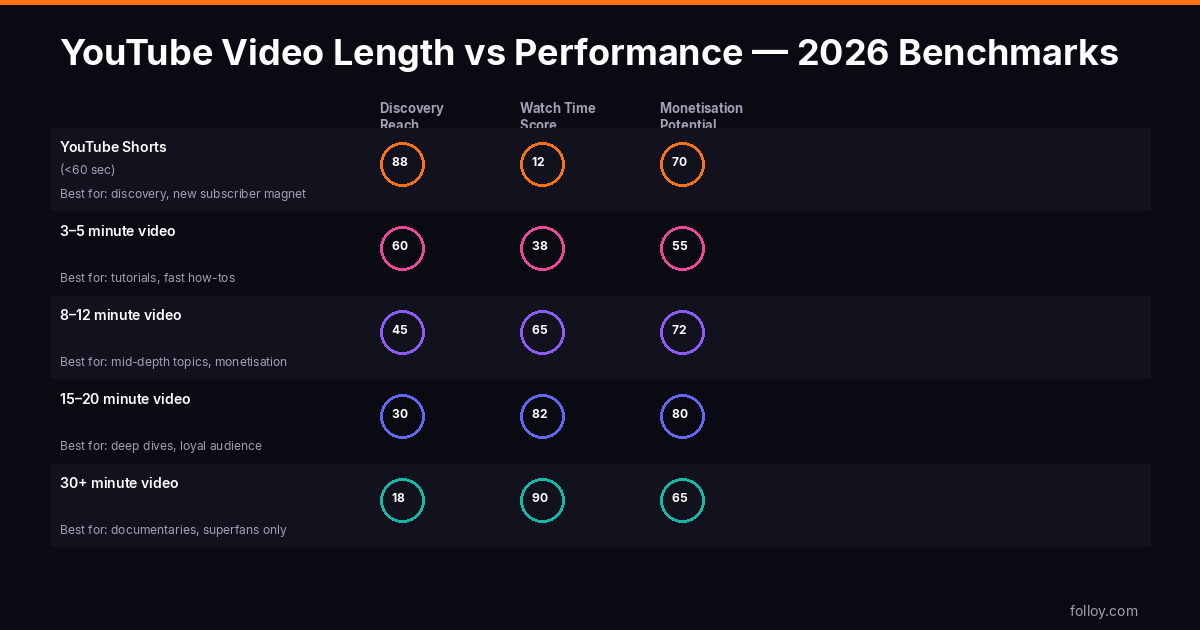
YouTube Shorts (vertical videos under 60 seconds) now receive 70 billion daily views globally. For growing channels, Shorts act as a discovery engine that feeds subscribers into your long-form content.
How to use Shorts to grow a long-form channel
- Repurpose highlights from your long-form videos as Shorts, with a link to the full video in the description
- Create standalone Shorts that tease a topic you cover in depth in a full video
- Post 3–5 Shorts per week in addition to your regular long-form uploads
- Hook within the first second: no introductions, no music intros, straight to the point
Note: Shorts subscribers sometimes convert to long-form viewers, but not always. If your niche performs well in both formats, use Shorts for discovery and long-form for monetisation and depth. If the audiences don’t overlap well, use separate channels or focus on whichever format your niche actually prefers.
7. Posting schedule and consistency
YouTube rewards channels that post on a consistent schedule. Viewers who know to expect a new video every Tuesday are more likely to come back repeatedly, and return viewers generate higher session metrics.
- Long-form: 1–2 videos per week is the recommended starting schedule. A well-made weekly video outperforms two rushed biweekly videos every time. Do not sacrifice quality for volume.
- Shorts: 3–5 per week, separate from your long-form schedule
- Best upload times: 2–4 PM on weekdays in your audience’s primary timezone. Verify with YouTube Studio analytics once you have traffic data.
8. Community tab and channel memberships
Available once you reach 500 subscribers, the Community Tab lets you post text updates, polls, images, and GIFs to your subscriber feed. Use it to:
- Post polls about upcoming topics to build pre-engagement before a video publishes
- Share behind-the-scenes progress on upcoming videos
- Tease upcoming video titles and ask subscribers which they want first
Community engagement increases how often YouTube recommends your new videos to subscribers who interact with your Community posts. Growing your free YouTube subscribers base makes this Community Tab distribution reach more people from the start.
9. Collaborations and cross-channel growth
Appearing on another creator’s channel (even as a guest in a single video) can bring hundreds or thousands of new subscribers from a pre-qualified audience that already watches content in your space. Target creators with channels 2–5× your size for collaboration pitches, and propose formats that genuinely serve both audiences rather than just cross-promotional shoutouts.
10. Analytics: the metrics that matter
Review YouTube Studio analytics weekly and focus on:
- Impressions CTR: What percentage of people who see your thumbnail click. Under 4% means the thumbnail needs work. 6–10% is a strong performer.
- Average View Duration: For long-form videos, above 40% is good. Above 55% is excellent.
- Traffic source breakdown: How are people finding your videos? This shows whether your SEO or recommendation strategy is actually working.
- Subscriber conversion per 1,000 views: Which videos convert viewers to subscribers most efficiently? Make more of those. High-performing videos can also benefit from amplifying initial engagement with free YouTube likes to extend their recommendation window.
YouTube performance benchmarks by video length
| Video length | Target CTR | Target avg view duration | Target avg % viewed | Notes |
|---|---|---|---|---|
| Shorts (under 60s) | N/A (Shorts feed) | 40–55 seconds | 75%+ | Completion rate is the key signal for Shorts |
| 2–5 minutes | 4–8% | 1:30–2:30 | 45–55% | Strong hook critical; most drop-off in first 30s |
| 5–10 minutes | 4–7% | 3:00–5:00 | 40–50% | Sweet spot for YouTube SEO + ad revenue |
| 10–20 minutes | 3–6% | 5:00–9:00 | 35–45% | Chapter markers and strong re-engagement points required |
| 20+ minutes | 3–5% | 8:00+ | 30–40% | Only viable with proven engaged audience |
Frequently asked questions about YouTube growth
How long does it take to reach 1,000 subscribers on YouTube?
With consistent weekly uploads in a defined niche and proper SEO, most channels reach 1,000 subscribers within 6–18 months. Channels that also post Shorts consistently tend to get there faster.
How do I get my YouTube videos recommended?
High click-through rate (CTR) combined with high average view duration (AVD) are the two primary triggers for YouTube recommendations. Improve your thumbnail for CTR; improve your script and pacing for AVD. Both need to be strong at the same time.
Does YouTube SEO still work in 2026?
Yes — SEO-driven search traffic is one of the most compounding, long-term growth channels YouTube offers. A well-optimised video ranking for “how to do X” can drive consistent views and subscribers for years after it is published.
Should I focus on Shorts or long-form YouTube videos?
Both, ideally. Use Shorts for discovery and audience top-of-funnel, use long-form for depth, watch time, and monetisation. If you have to choose one, match it to your audience: younger audiences and entertainment niches lean toward Shorts; education, reviews, and professional skills tend to perform better as long-form.
What is a good average view duration for YouTube?
For videos 5–10 minutes: 40–50% is good. For videos over 10 minutes: 35–45% is good. For Shorts: 75%+ completion rate is the target. Focus on improving your hook (first 30 seconds) before anything else, which is where most drop-offs happen.

What readers are saying
Real reactions from creators in the Folloy community.
The point about thumbnails being more important than the video title is so underrated. I redid my last 10 thumbnails and CTR went from 3% to almost 7%. Same videos, just better packaging.
needed this. i’ve been posting weekly for 6 months and stuck at 400 subs. the bit about niche consistency hit hard — i’ve been all over the place with topics.
Solid advice but i’d push back slightly on the upload frequency part. Quality over quantity worked better for me than forcing 2 videos a week. burned out fast trying to hit a schedule.
same here, i went from 3x a week to 1 really good video and my watch time actually went up. burnout is real.
bookmarking this. the section on the first 30 seconds determining retention is gold. started reworking my intros and my avg view duration jumped almost 40 seconds.