

Instagram Reels in 2026 is the platform’s primary growth lever, but the rules for winning on Reels are not the rules for winning on the rest of Instagram. The grid still matters for identity, but the reach comes from short-form video pushed into the Reels tab, the Explore feed, and DMs. Here is what is actually working for accounts growing right now, and what most of the year-old advice gets wrong.
Reels is a discovery engine, not a content type
It helps to stop thinking of Reels as “the video format” and start thinking of it as the discovery layer of Instagram. Most new follows on a growing account in 2026 come from someone in the Reels tab who has never seen the creator before. The Reels ranking model is closer to TikTok’s FYP than it is to Instagram’s old follower-feed logic, which means the audience deciding whether you grow is the audience that does not already follow you.
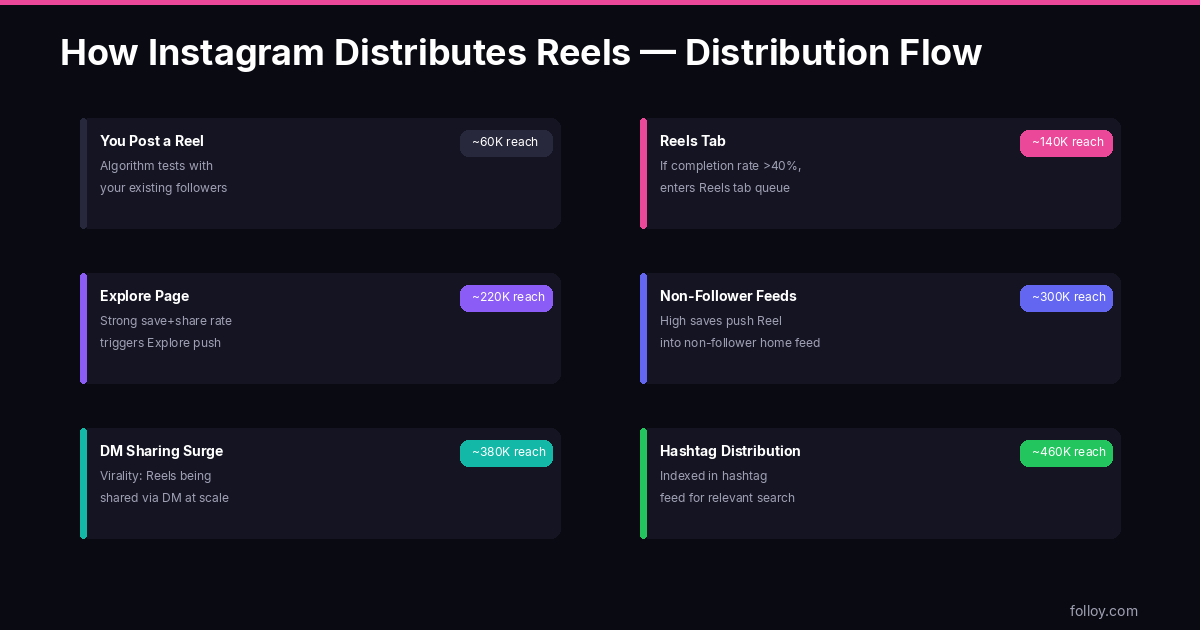
This has a practical implication: assuming context (“as you all know”) is fatal. Every Reel should open as if the viewer has never seen the account before, because statistically they have not.
The Reels algorithm in 2026: what has changed from 2024
Instagram’s Reels ranking model has shifted noticeably from its 2024 configuration, and creators still running on 2024 assumptions are leaving reach on the table.
DM shares now carry more weight
The single biggest signal change in 2025 and into 2026 is that direct-message shares have been significantly upweighted in the Reels ranking model. A Reel that gets shared to DMs at a high rate relative to its reach is a signal that the content is genuinely useful or entertaining to the recipient, not just passively watched. Instagram treats this as a strong quality signal and rewards it with broader distribution. The practical implication: content designed to be sent to a specific person (“tag a friend who needs this” or “send this to your gym partner”) outperforms content designed purely for public consumption.
Watch-through rate vs completion rate
Instagram used to heavily weight completion rate — whether viewers watched to the exact end. In 2026, the signal that matters more is watch-through rate: did viewers watch more than 75 percent of the video? This distinction matters because it changes the ideal Reel length. A 45-second Reel where most people watch 38 seconds now outperforms a 20-second Reel where most people watch exactly 20 seconds but immediately scroll. The algorithm is trying to identify content that genuinely held attention, not content that was short enough to complete accidentally.
Saves remain strong; likes have weakened
Like counts have become a weaker ranking signal year-over-year as Instagram recognizes they are easily inflated and do not predict genuine interest. Save counts remain a strong signal because saving a video requires intentional action. Shares (especially DM shares) and saves are the two engagement actions most worth optimizing for in 2026.
Hook formulas that convert on Reels specifically
Reels hooks operate on a slightly different psychological clock than TikTok hooks. The viewer’s decision window is around 1.5 seconds, and the combination of the opening visual and the first audible word carries the decision. These five formulas work consistently on Reels specifically:
1. The visible result open
Start with the finished state and work backwards. Example: open on a beautifully plated meal, then cut to the 10-minute prep process. The viewer who wants that result has already committed. Works especially well in food, fitness, home decor, and craft niches.
2. The counter-intuitive statement
Open with a claim that contradicts common advice in your niche. “I stopped tracking macros and lost more weight.” The viewer who disagrees wants to argue; the viewer who suspects this is true wants to learn. Either way, they keep watching. The Reel must pay off the claim with evidence or explanation — a bait-and-switch kills saves and shares.
3. The “watch to the end” setup
Open by explicitly stating that the most useful part is at the end. “I’ll give you the three tactics at the end, but you need the context first.” This hooks the saves-focused viewer and pushes watch-through rate up. Use sparingly — if every Reel promises a reveal, the promise loses credibility.
4. The mid-action cold open
Begin recording mid-task with no introduction. The viewer walks in on something already happening. “Okay, thirty seconds into this and it is already not working — let me show you why.” Creates immediate stakes without setup time. Works in tutorial, cooking, DIY, and reaction-style content.
5. The direct challenge
Address the viewer by calling out a specific belief or behavior they hold. “If you’re doing cardio before weights, you are doing it backwards.” The viewer who recognizes themselves in the description is already partially engaged. Works best when the belief is widely held in your niche and the correction is genuinely useful.
Audio strategy: trending sounds vs original audio
Trending audio still provides a meaningful cold-start lift on Instagram — more so than on TikTok in 2026 — but only during a specific window of the audio’s lifecycle.
When trending audio helps
The useful window is when an audio track is in the 5,000 to 30,000 uses range and its usage is growing daily. At this stage, Instagram’s algorithm is actively pushing the audio and content using it gets a distribution boost from the audio’s own momentum. By the time an audio is visibly trending on the Reels tab and has 200,000+ uses, the saturation of competing content has largely cancelled out the boost.
The accounts that use trending audio most effectively scan the Reels tab daily and identify sounds that are just beginning to rise. Using the audio 48 to 72 hours into its growth curve typically captures the peak boost window.
When original audio wins
Original audio is the better choice for content that is evergreen, highly niche-specific, or where the audio does not add anything that a trending sound would. More importantly, original audio builds a secondary growth channel: when other creators remix your sound, your profile is linked as the original creator. Successful original audio can become a slow-burn source of profile visits and follows for months after the original Reel has peaked.
Trending audio borrows reach; original audio builds it. For creators past the 1,000-follower mark who want long-term compounding, the ratio should shift gradually toward more original audio.
The collaboration multiplier: collab posts on Reels
Instagram’s collab post feature — where two accounts co-author a single Reel that appears on both profiles — is one of the most underused growth mechanics for mid-size creators in 2026. A collab post distributes to both accounts’ audiences simultaneously, and the post appears on both profiles’ grids.
How to identify collab partners
The ideal collab partner is an account in an adjacent (not competing) niche with a similar or slightly larger following. Adjacent means their audience would plausibly be interested in your content but does not already follow you. Same-niche collabs can feel competitive; adjacent-niche collabs feel additive to both audiences. Look for accounts where 30 to 50 percent of their audience overlap would be interested in your topic.
How to pitch
Send a DM that leads with the specific value the collab provides to their audience, not to you. Describe the Reel concept in one sentence. Propose a concrete date and format. Creators at similar follower counts are approachable; do not wait until you feel “big enough” to pitch. A 3,000-follower account pitching a 7,000-follower account with a specific, value-clear concept gets a response more often than the follower gap suggests.
Executing the collab post
One creator films, edits, and posts. The other accepts the collab invite within 24 hours. Coordinate captions in advance — both accounts’ captions should be distinct but reinforce the same core idea. The posting day should be when both accounts’ audiences are typically most active. After posting, both creators should reply to comments actively in the first two hours to compound reach.
Reels ranking signals: what matters most in 2026
| Signal | Weight in 2026 | Change from 2024 | How to optimise |
|---|---|---|---|
| DM shares | Highest | Significantly upweighted | Create send-to-a-friend moments; target relatable or useful content |
| Watch-through rate (75%+) | Very high | Replaced completion rate as primary | Optimal length 30-60s; cut dead air; strong pacing throughout |
| Saves | High | Stable | Make reference content worth bookmarking: checklists, tutorials, comparisons |
| Comments | Medium-high | Stable | End caption with a binary-choice or fill-in-the-blank prompt |
| Like count | Lower than before | Downweighted year-over-year | Do not optimise for likes — optimise for saves and shares |
| Profile visits from Reel | Medium | Stable | Strong bio CTA; pinned Reels convert profile visits to follows |
Reels analytics deep-dive: the 4 metrics that predict growth
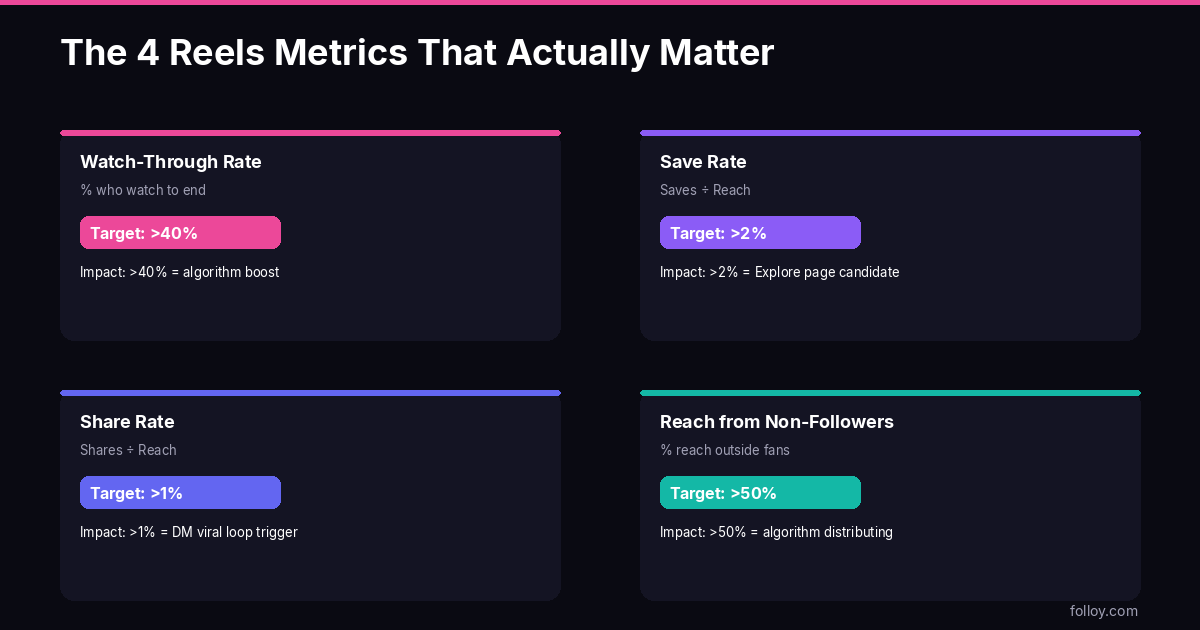
Instagram’s native analytics show more data than most creators use. These four ratios are more predictive of future growth than raw view counts.
Play rate
Play rate is views divided by accounts reached. A high play rate (above 80 percent) means your cover frame and audio are compelling enough that most people who see the Reel in their feed actually play it. A low play rate is a cover frame or audio problem, not a content quality problem. Fix the thumbnail before re-cutting the video.
Shares per reach
Shares divided by accounts reached. This is the metric most directly correlated with breakout Reels in 2026. A shares-per-reach ratio above 0.5 percent means roughly 1 in 200 viewers is actively sending the Reel to someone. Above 1 percent is exceptional and typically precedes significant reach spikes. If your shares-per-reach is below 0.1 percent consistently, the content is watchable but not memorable enough to send.
Follows per reach
New follows divided by accounts reached. Above 0.5 percent is strong for Reels. Below 0.1 percent means viewers are enjoying the content without connecting it to an account they want more from — usually a sign the creator’s identity is not coming through clearly enough in the video, or the content is so one-off that there is no obvious “series” reason to follow.
Saves per reach
Saves divided by accounts reached. Above 0.3 percent is strong. High saves predict algorithmic re-circulation of the Reel days or weeks after the original post — Instagram surfaces highly-saved content in Explore periodically, giving older Reels a second wave of reach. Optimizing for saves means making content genuinely worth revisiting: checklists, step-by-step tutorials, product recommendations, or dense information.
GEO differences: Reels performance by region
Reels performance varies significantly by geography, and understanding these differences helps creators set realistic expectations and tailor their approach.
North America. The most competitive Reels environment. English-language content competes across an enormous creator pool and average reach-per-follower for accounts under 10K is lower than most other regions. DM share rates are particularly important in the US because the audience is more selective. Accounts that succeed tend to be highly specific in their niche rather than broadly appealing.
Western Europe. UK, Germany, France, and the Netherlands have dense creator markets but audience engagement rates are typically higher than North America — saves-per-reach and shares-per-reach both tend to run higher for accounts in the same niche size. German and French language content has noticeably lower creator competition than English equivalents in most niches.
India. One of the fastest-growing Reels markets in 2026. Hindi-language content is highly competitive, but regional language content in Telugu, Tamil, and other languages has lower creator density and higher organic reach potential. The Indian audience skews heavily toward entertainment and lifestyle content, and tutorial content that solves a practical problem tends to generate strong save rates.
MENA. Arabic-language Reels are in a strong growth phase. TikTok’s restrictions in several MENA markets have pushed creators and audiences toward Instagram Reels, which is expanding both the creator and viewer base rapidly. Creator supply is still below viewer demand in many niches, which translates into faster organic growth for disciplined accounts.
Latin America. Brazil’s Portuguese-language market and the Spanish-language LATAM market are both significant and distinct. Brazilian creators on Reels see very high share rates — DM sharing culture is strong — which benefits the 2026 algorithm’s weighting. Spanish-language LATAM content competes across a large geography but audience growth is outpacing creator growth in several categories including personal finance, health, and education.
If you are creating content for a specific region, use location-relevant audio trends, reference local cultural context where natural, and post at times that align with peak active hours in that geography rather than generic “best time to post” advice based on global averages.
What is not worth your time on Reels in 2026
- Hashtag spam. Hashtags now provide near-zero reach on Reels. Three relevant tags is the new ceiling; thirty does nothing.
- Reposting TikToks with the watermark. Instagram’s classifier still detects the watermark and suppresses reach. Re-export from the source files.
- “Engagement first-comment” pinning. Largely neutralized; spend that effort on the caption itself.
- Cross-posting identical content same day. Same-day duplicates rarely both perform. Pick the platform you are prioritizing for each piece.
The compounding effect
Accounts that grow on Reels in 2026 almost all show the same shape: flat for three to six weeks, then a single Reel that does 5x to 50x normal reach, then a noticeably higher floor for the next month, then another breakout. The compounding is real but it is choppy. Creators who quit during the flat stretches never see it; creators who keep posting through the flat stretches almost all eventually do.
Some creators use free Instagram views to seed early momentum on new Reels, particularly in the first 48 hours when the algorithm is sampling how the content performs. This can widen the initial distribution window, but it compounds meaningfully only when paired with genuinely strong watch-through rates and share signals — otherwise the seed views do not translate into algorithmic reach. Pair this with consistent content quality and strong hook formulas, and you will see the compounding effect much faster. Accounts that also build free Instagram likes on early posts can strengthen the social proof signal on their profile grid, which lifts the profile-visit-to-follow conversion rate for viewers arriving from the Reels tab.
Reels performance by region in 2026
| Region | Reels reach potential | Dominant content style | Notes for creators |
|---|---|---|---|
| North America (US/Canada) | High but competitive | Entertainment, lifestyle, education | Most saturated market; strong brand deal ecosystem |
| Western Europe | Medium-high | Lifestyle, food, fashion, professional | Local-language content outperforms English |
| India | Very high | Entertainment, DIY, finance | TikTok banned — Reels dominates short-form; massive underserved audience |
| MENA | High, fast-growing | Lifestyle, food, humour | Arabic-language content significantly underserved; rapid Reels adoption |
| Latin America | High | Entertainment, beauty, food | Spanish/Portuguese content strong; influencer budgets growing fast |
| Southeast Asia | Medium-high | Lifestyle, food, beauty | TikTok stronger here; Reels works well for creators targeting diaspora |
Frequently asked questions
How many Reels should I post per week?
Four to seven is the defensible range for accounts actively trying to grow. Below four, Instagram’s algorithm treats the account as low-frequency and depresses reach on each post. Above seven, production quality tends to drop and a low-quality Reel can suppress reach on the two or three posts that follow it. For most creators, five solid Reels per week is the best balance of frequency and quality.
Why are my Reels getting views but no follows?
This is a follows-per-reach problem, which almost always points to one of two issues: either the creator’s identity is not visible enough in the video (viewers enjoy the content but cannot tell who made it or why they should follow for more), or the content is too one-off (viewers watched the Reel but do not see a clear reason to follow for similar content). Fix by making your format more consistent, adding a brief creator-identity moment near the end, or being more explicit about what the account produces.
Do Reels perform better at certain times of day?
Somewhat, but the effect is weaker than most scheduling advice implies. Posting during your audience’s peak active hours gives the Reel a stronger first-hour engagement window, which matters for algorithmic distribution. For most accounts targeting adults in Western markets, early morning (6-9 AM) and evening (7-10 PM) in the target time zone are the strongest windows. But a Reel posted at the “wrong” time that earns strong engagement still outperforms a Reel posted at the “right” time with weak engagement.
Should I use the Reels template feature?
Templates are useful for speed, not for differentiation. If you find a template that fits your content style, using it can cut editing time significantly. But templates that are widely used tend to produce a visual sameness that makes it harder for your content to stand out. Use templates for formats where the editing style is incidental (talking-head tutorial, single-clip demo) and create custom edits for content where the format itself is part of the hook.
Does posting Reels hurt my photo content’s reach?
No. Instagram does not penalize photo or carousel content for accounts that also post Reels. The two content types distribute through different pathways: Reels primarily through the Reels tab and Explore, photos and carousels primarily through the follower feed and hashtag pages. The accounts growing fastest in 2026 typically post Reels for discovery and carousels for retention — the depth of content that keeps existing followers engaged.
Is it too late to grow on Instagram Reels?
No, but the path looks different than it did in 2021 or 2022. Early Reels adopters had a genuine first-mover advantage in most niches. Today, growing on Reels requires more precise execution: a clear niche, consistent hook formulas, and a steady output of content that earns shares and saves rather than just views. The platform is more competitive, but the audience is also larger than it has ever been, and new niches open as culture shifts. Creators who enter with a disciplined playbook in 2026 are not too late.
What readers are saying
Real reactions from creators in the Folloy community.
The “first frame is your real thumbnail” tip changed my whole approach. I started putting text + a clear visual on frame one and my reels finally stopped dying in the first second.
original audio over trending audio is a hot take but i think you’re right. my trending-audio reels did okay but the ones with my own voiceover got way more saves and comments.
the loop trick (ending where you started so it replays) genuinely doubled my watch time. such a small thing.
right?? the seamless loop is criminally underused. extra views for basically zero extra effort.
appreciated the realistic timeline. i kept expecting one reel to blow up overnight but it was the 30th one, not the 3rd. consistency really is the cheat code.