

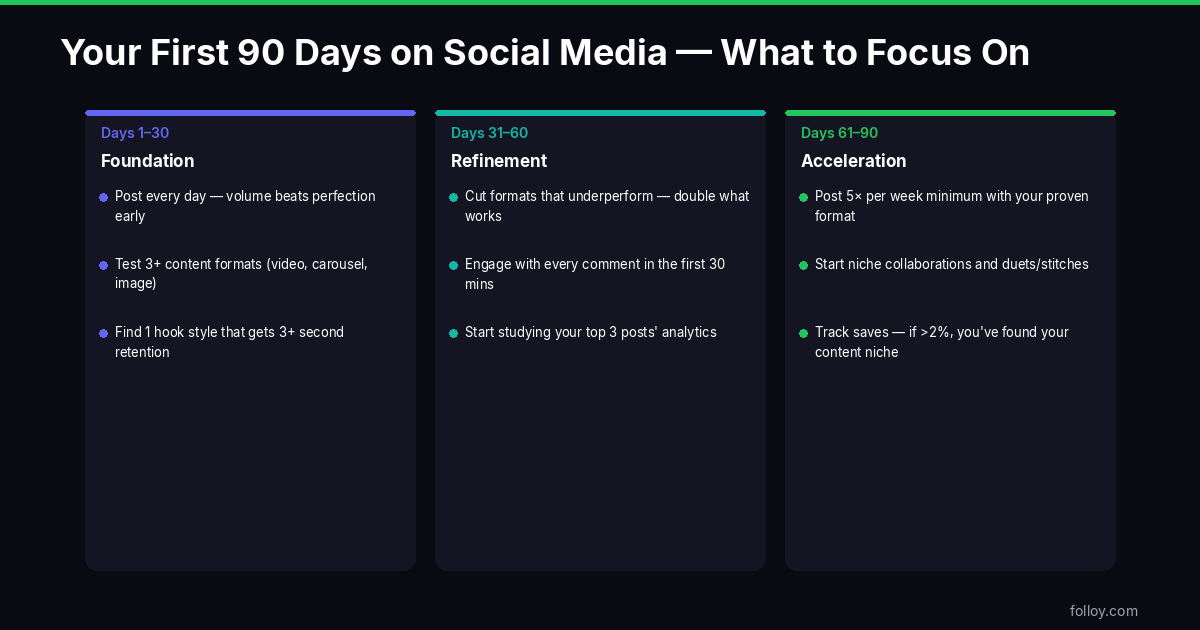
The first 90 days on a new creator account decide more than people think. Almost everything an account becomes — its audience, its niche fingerprint, its growth trajectory — is set in the first three months and then iterated against. This checklist is the version most growth-stage creators on TikTok and Instagram in 2026 would write down if they had to start over. Keep it open while you work through each phase.
90-day milestone targets
| Day range | TikTok target | Instagram target | Primary metric |
|---|---|---|---|
| Days 1–7 | Profile complete, 3 videos posted | Profile complete, 3 Reels posted | Setup done |
| Days 8–30 | 100+ followers, 50%+ avg watch time | 50+ followers, 3+ Reels per week live | Watch time % / posting consistency |
| Days 31–60 | 500–1,000 followers | 200–500 followers | Follow-from-view rate |
| Days 61–90 | 1,000–3,000 followers | 500–1,500 followers | Weekly follower growth rate |
Days 1-7: foundation setup
Most creators post on day one. The accounts that grow fastest almost never do. The first seven days are setup, not content — and the setup decisions made here affect everything that follows.
TikTok setup checklist
- Decide the lane before anything else. Write one sentence: “videos about X for people who Y.” If you cannot fit it in one sentence, narrow until you can. “Quick home workouts for people with no equipment” is a lane. “Fitness content” is not.
- Profile photo. Readable at 40-pixel size. A face or a simple icon. Not a busy illustration or a logo with small text.
- Bio. Under 80 characters. States what the account produces and implicitly who it is for. No hashtags in the bio — they do not help discoverability and they crowd the text.
- Account set to public. Private accounts get no cold-start distribution. This is not optional.
- Username. Simple enough to say aloud. Memorable is better than clever. On TikTok, name recognition matters less than on other platforms because the algorithm distributes to non-followers, but a confusing username reduces profile-visit-to-follow conversion.
- Niche audit: find 15 reference accounts. Ten in your exact niche, five in adjacent niches. Save their top five videos by view count. Study hook structure, not topic. What do the opening three seconds look like across these videos? Note the formats that appear repeatedly — those are audience-tested.
- Film 5 videos before posting any. The first three posts carry outsize weight. Do not learn on them. Film a batch, watch them back cold the next morning, and post the three you believe in most.
Instagram setup checklist
- Switch to a Creator or Business account. This unlocks analytics and scheduling tools that you will need in week two. Do this on day one, not day fifteen.
- Profile photo. Same rule as TikTok: recognizable at 40 pixels. Consistency across both platforms makes cross-platform discovery easier as you grow.
- Bio with line breaks. Instagram bios render line breaks, so use them. First line: what you make. Second line: who it is for or what they get. Third line: link or call to action. Keep each line under 35 characters.
- Cover frame template. On Instagram, the profile grid is a first impression for profile visitors who arrived from a Reel. Set up a simple cover frame template before you post your first Reel — same font, same color placement, same composition. Consistency signals format at a glance. A chaotic grid undermines the follow decision.
- Link in bio. If you have a website, a newsletter, or a link tree with relevant content, add it now. Profile visitors from Reels often click the link before deciding to follow.
- Research what is working in your niche. Spend 30 minutes in the Reels tab searching your niche topic. Save 10 Reels that have high engagement relative to the account’s follower count — these are the hooks and formats your target audience responds to.
Days 8-30: content rhythm
The first batch of posts is where most new creators diverge from what the data actually suggests. This phase is about posting your strongest material on the right cadence and reading early signals without overreacting to noise.
What to post
- Post your three strongest videos first. Not the first three you filmed — the three that test best when you watch them back cold the next morning. Rewatch each with the sound off. If the opening frame does not immediately communicate the value, re-cut before uploading.
- Every post must answer the one-sentence description. Any video in this window that could have been posted by a different type of account is a problem. Drift in week three kills the compound growth that was building.
- Lead with the hook, not the background. The opening three seconds on TikTok and the opening 1.5 seconds on Instagram Reels carry the entire decision. No long intros, no talking about yourself, no explaining what the video will cover. Start in the middle of the value.
- Plan for both platforms if running both. Same source footage can serve TikTok and Reels, but cut separately. TikTok rewards faster pacing; Instagram Reels rewards a stronger cover frame and cleaner editing. Plan 20 to 30 percent additional production time for dual-platform output.
How often to post
- Set a rhythm you can sustain for 90 days. Daily if realistic. Every other day if not. Three times a week is defensible. Four times a day is rarely sustainable and produces filler content that suppresses your account’s average engagement ratio.
- TikTok. The algorithm rewards consistency more than high frequency. Three solid posts per week outperforms seven rushed posts per week for most creators.
- Instagram Reels. Instagram is less forgiving of quiet periods than TikTok. Going dark for a week measurably depresses the next Reel’s reach. Four to five Reels per week is the minimum for active growth; below that, the algorithm treats the account as low-frequency.
How to read early data
- Read analytics weekly, not daily. Daily reads cause emotional reactions to noise. A single bad-day data point tells you nothing. Weekly reads expose real patterns.
- TikTok: watch-time ratio is the primary signal. Go to Creator Analytics, Content tab. For each video, note the average watch percentage. Below 35 percent means the hook or pacing is failing. Re-cut for tighter openings before posting more in that format.
- Instagram: play rate and shares-per-reach matter most early. Play rate (views divided by accounts reached) tells you if the cover frame is working. Shares-per-reach above 0.5 percent is the strongest early signal of breakout potential.
- Do not delete underperformers. Low-view videos do not hurt the account; they just do not help. The algorithm reads recent performance, not lifetime average. Deleting rarely changes anything and removes a data point you can learn from.
Days 31-60: double down on what works
By day 30, you have enough data to stop guessing. This phase is pattern recognition — identifying what is working and deliberately producing more of it.
The analytics review process
- Identify your top three videos from the first 30 days. Rank by share count and follows-from-view, not by raw view count. A video with 50,000 views and zero follows is worse for your account than a video with 5,000 views and 200 follows. Vanity views do not predict growth; engagement signals do.
- Write down the through-line. What do those top three videos have in common that the others do not? It is rarely the topic. Usually it is the hook structure, the pacing, the specific angle, or the level of specificity. “I started with a counter-intuitive claim” is a finding you can use. “The topic was popular” is not.
- Run hook experiments. Take one solid content idea and cut two or three different opening hooks. Post them as separate videos several days apart. The variation that drives higher watch-time ratio on at least 500 views is the hook formula to carry forward. Accumulate these findings in a notes file — by day 60 you should have 8 to 10 proven openers.
Content pivots: when to make them and when not to
- Pivot the format, not the niche. If your top videos are in a consistent niche but a specific format is underperforming, pivot the format. Do not pivot the niche because three videos underperformed — that is noise, not signal.
- Pivot the niche only if the data is clear and consistent. If your top-performing videos are consistently about a subtopic that is adjacent to your stated lane, and your core lane content is consistently underperforming across 10+ videos, the audience is telling you something. Narrow toward what is working, but do it gradually, not in a single sudden shift.
- Commit the next 10 videos to the through-line. This is where most accounts break out for the first time. Concentrated signal in a short window gives the algorithm enough data to push the content more aggressively.
Community mechanics that compound reach
- Reply to every comment in the first hour. Comment threads compound reach because each reply triggers fresh engagement. At this stage of growth, replying to 20 comments takes ten minutes and consistently adds to distribution.
- Stitch or duet one video per week (TikTok). Accounts 3x to 10x your size in your niche are the right targets. Your commentary or reaction exposes your account to their audience in a context where they are already interested in the topic.
- Use free TikTok views to widen the test pool on high-effort videos. When you have produced a video you believe in that has a strong hook and good pacing, widening the initial distribution gives the algorithm more data to work with in the first 24 hours. Pair with genuine content quality — views without watch-time retention do not compound.
Days 61-90: cross-platform thinking
By day 60 you know what works on your primary platform. Days 61 to 90 are about building toward sustainability and — if you were single-platform — deciding whether to add the second.
When to add the second platform
- Add it when your primary platform output is on autopilot. If posting on TikTok still requires full creative concentration, adding Instagram will dilute both. The signal is: can you produce your standard TikTok content in the time you expected when you started?
- The right followers give you the readiness signal. If your TikTok followers are also asking where to find you on Instagram (or vice versa), the audience is telling you there is demand for the second platform. That is a better signal than any follower count threshold.
- Start with 60 percent of your primary-platform cadence. If you post five times a week on TikTok, start with three times a week on Instagram. Maintain quality on both rather than maximizing frequency on either.
Cross-platform content workflow
- Film with both platforms in mind. Shoot the full scene you need for TikTok, then shoot the additional coverage you need for the Instagram cut. Do not add 50 percent more filming time — add 15 to 20 percent.
- Export separately. Never post an export with a TikTok watermark to Instagram Reels — Instagram’s classifier suppresses it. Re-export from source files for each platform.
- Use free Instagram followers as a profile credibility signal when launching the second platform. Arriving on Instagram with your TikTok following already reflected in your social proof improves the conversion rate for new profile visitors who discover you through Reels. It reduces the “empty room” effect that slows momentum on a brand-new Instagram account.
- Different captions for each platform. TikTok captions are mostly skipped; Instagram captions are read. Write platform-appropriate copy for each — do not copy-paste the same text.
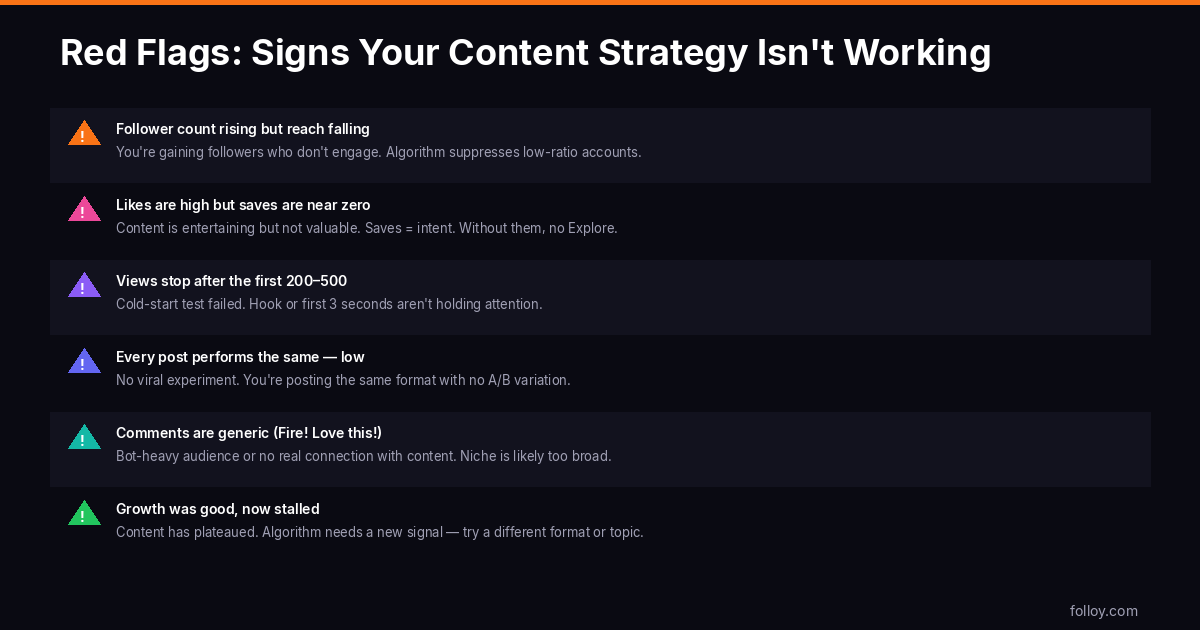
Red flags at each stage: what tells you something is wrong
Days 1-7 red flags
- You cannot write the one-sentence niche description — the lane is not specific enough yet.
- Your reference account audit found fewer than 5 accounts in your exact niche — the niche may be too narrow to have a viable audience, or your search terms need broader synonyms.
- You have already posted before filming a batch — the first-three posts window is partially burned.
Days 8-30 red flags
- Watch-time ratio below 30 percent on every video — the hook is failing across the board, not just occasionally. Recut all future videos with tighter openings.
- Zero shares across 10 posts — the content is watchable but not memorable. Add a clear “pass this along” hook or a screenshottable moment.
- You have already posted content from outside the niche description — the signal is diluting. Audit your last 10 posts and correct course immediately, not gradually.
Days 31-60 red flags
- No video has outperformed your average by more than 1.5x in 30 days — the niche or hook structure needs adjustment, not just more content.
- Follows-from-view is consistently below 0.1 percent — viewers are not connecting content to a creator worth following. The creator identity is not coming through.
- You have pivoted the niche twice already — this is a sign of chasing performance data rather than committing to a lane. Stop pivoting and post 10 consistent videos before making any further changes.
Days 61-90 red flags
- You added the second platform before your primary platform is on autopilot — quality will drop on both. Pause the second platform and get consistent on the first.
- You are posting identical exports to both platforms — you are underperforming on whichever you care about more. Separate the cuts.
- Your top video from the first 90 days is an outlier with no clear through-line to your other content — the breakout may have attracted an audience that does not fit your niche. Check: are your new followers engaging with your subsequent posts? If not, the breakout was a false signal.
Red flag diagnostics
| Symptom | Most likely cause | Fix |
|---|---|---|
| Under 100 views after 48 hours | Weak hook or too-broad niche | Rewrite the first 3 seconds; narrow your topic |
| Views but zero follows | Profile doesn’t convert | Rewrite bio and pin your best video |
| High views, low watch time | Hook overpromises; content doesn’t deliver | Match content to hook; cut the intro |
| Good first week, then collapse | Inconsistent posting or niche drift | Post daily for 14 days straight in one topic |
| Stuck below 500 followers for 60+ days | No follow-from-view signal | End every video with an explicit reason to follow |
GEO note: regional content calendars
TikTok and Instagram trends move at meaningfully different speeds depending on geography, and creators who calibrate to their actual region outperform those following generic global trend reports.
In North America and Western Europe, platform-wide trends (sounds, formats, challenges) typically originate and peak within 5 to 10 days. By the time a trend is written up in a marketing newsletter, it is usually past its peak reach window. To use trends effectively in these markets, you need to be on the platform daily and act within the first 48 hours of a trend emerging.
In Southeast Asian markets — particularly Indonesia, Vietnam, Thailand, and the Philippines — trends often have a longer effective window, sometimes 2 to 3 weeks, because the creator density is lower relative to the viewer base. A creator in these markets has more time to create trend-responsive content without competing against a saturated field of similar videos.
Indian regional language markets (Telugu, Tamil, Marathi, Bengali) move at different speeds from the Hindi-language market, and trends often circulate within language communities rather than across all of India simultaneously. A trend that is peaking in Tamil-language TikTok content may just be starting in the Telugu-language equivalent. Cross-language trend adaptation — producing the same concept in a different regional language — is an underused tactic in these markets.
MENA creators should note that Friday and weekend posting patterns differ from Western markets due to different weekly rhythms. Peak active hours on TikTok and Instagram in Gulf countries cluster later in the evening (9 PM to midnight local) compared to Western markets, and weekend patterns are Thursday-Friday rather than Saturday-Sunday. Scheduling content to these actual peaks rather than default app recommendations can meaningfully improve first-hour engagement.
Frequently asked questions
Should I start on TikTok or Instagram first?
Start on whichever platform you already use as a viewer. Familiarity with the consumption experience translates into better intuition about what works. TikTok’s cold-start algorithm is slightly more forgiving for brand-new accounts, which makes it marginally easier to get early data. Instagram’s audience tends to be slightly older in most Western markets. If your target audience skews under 25, TikTok first; if it skews over 30, Instagram Reels first.
How do I know if my niche is too narrow?
Check if at least 10 other creators are actively posting in your exact niche and getting meaningful views. If you cannot find 10 accounts, the niche is either too narrow or the search terms you are using are too specific. A niche that is too narrow does not mean the content is bad — it means the algorithm cannot find enough similar viewers to distribute to. The fix is usually to widen by one degree: “sourdough bread for beginners” instead of “sourdough rye bread with einkorn flour.”
What if I get a viral video early and my other videos do not?
This is a common and disorienting situation. A viral video early in an account’s life sometimes attracts an audience that does not match the account’s actual content lane. Check your follow-from-view on the viral video versus your non-viral videos — if the viral video’s followers are not engaging with subsequent posts, they are not your real audience. Keep posting to your lane consistently. The algorithm will build a more accurate audience model over time, and the mismatched followers become irrelevant.
Is posting every day necessary?
Not strictly, but consistency is. An account posting three times a week for 90 days outperforms an account posting daily for 30 days and then going quiet. The algorithm rewards accounts it can rely on for regular content. Set a cadence you can maintain with your actual production capacity, then stick to it. Missing a scheduled post is less damaging than setting an unrealistic schedule and burning out.
How long should I give a niche before deciding it is not working?
At least 30 days and 20 posts in the same niche before making a major pivot decision. A single underperforming video is noise. A pattern across 20 videos is signal. If after 30 days and 20 posts in a consistent lane your best video has under 500 views and your watch-time ratio is below 30 percent, the niche, the hook structure, or both need adjustment. Change one variable at a time — niche or hook structure, not both simultaneously.
When should I start thinking about monetization?
After the algorithm has a stable picture of your account, which is typically around the 1,000-follower mark with consistent engagement. Before that, optimizing for monetization (overly promotional content, affiliate links in every post, referencing brand deals that do not exist yet) tends to confuse the audience signal and suppress growth. Use the first 90 days to build the audience, then layer monetization on top of an account that already has momentum.
What readers are saying
Real reactions from creators in the Folloy community.
Starting both platforms next week and this checklist is exactly what i was looking for. The “don’t obsess over follower count in month one” advice already takes a load of pressure off.
the 90 day framing is smart. i quit way too early on my first account around week 3 because nothing was happening. turns out that’s completely normal.
love that this is realistic and not “go viral in 7 days” nonsense. the batch-filming tip in week 2 honestly saved my sanity.
batching is everything. i film a week of content sunday afternoon and it removed all the daily “what do i post” panic.