

There is a counter-intuitive pattern that shows up over and over in TikTok growth data: the broader your content, the smaller you usually stay. Creators who try to “appeal to everyone” almost always plateau under 5,000 followers, while creators in narrow, almost weirdly specific lanes routinely cross 100,000. The reason is not artistic. It is mechanical. Here is how TikTok’s classifier actually treats your account, why niching down works, and how to find the specific lane that’s right for your geography and category.
The classifier picks an audience for you
Every time you post a video, TikTok’s recommender has to decide which slice of its billion-plus users to show it to. It makes that decision in part by looking at your account’s history: which topics you have made before, which audiences engaged, and how tightly those audiences cluster. If your last twenty videos all triggered strong watch-time from a coherent group (say, beginner woodworkers in their twenties) the algorithm has a confident answer to “who is the next video for.” Your reach is high because the targeting is precise.
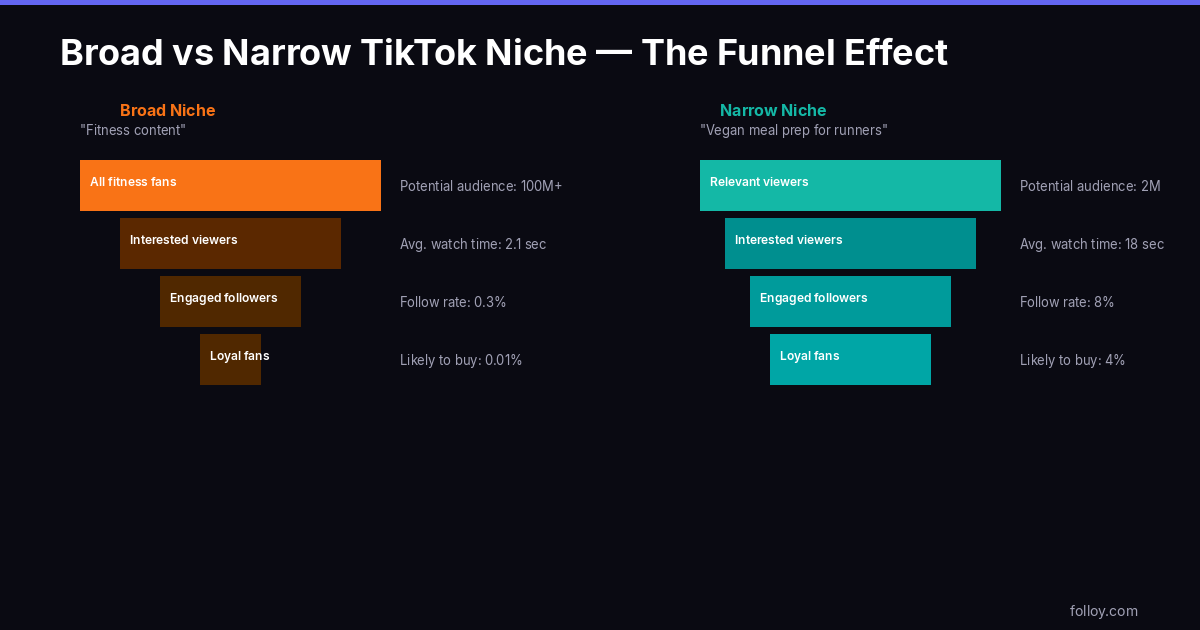
If your last twenty videos triggered moderate watch-time from twenty different micro-audiences (woodworkers, gym people, dog owners, travel watchers) the algorithm has no confident answer. It has to guess wider, the average watch-time drops, and the system stops pushing you. This is what creators call “the broad-content ceiling,” and it is real.
The 80/20 niche rule
The rough working rule among growth-stage creators in 2026: at least 80 percent of your videos should sit cleanly inside a single niche before you start mixing in adjacent content. Below 80 percent, the classifier never converges on a target audience and the rest of the system penalizes the account.
The 20 percent room exists for two reasons. Occasional cross-niche content can pull in a tangential audience that overlaps with your core. And rigid 100-percent-niche accounts get stale; watch-time decays. The 80/20 split keeps the classifier confident while leaving room for the account to breathe.
Niche selection by platform region
TikTok is not one homogeneous platform. The algorithm segments content regionally, and what works in one geography may not translate to another. Understanding this matters before you pick your niche, because the same content category can be saturated in one market and wide open in another.
Cooking niches: Southeast Asia vs the US
In Southeast Asia (specifically the Philippines, Indonesia, Thailand, and Vietnam), cooking content that dominates is heavily focused on budget meals, street food recreations, and regional home cooking. Filipino creators posting about how to make a full family meal under 100 pesos, or Indonesian creators replicating local warung dishes at home, get engagement rates that Western cooking niches rarely match. The specificity of ingredient and cultural context drives loyalty that generic “easy recipes” content cannot.
In the US market, cooking niches that perform in 2026 lean toward dietary identity (high-protein, low-carb, carnivore), speed constraints (5-ingredient, 15-minute meals), or strong aesthetic presentation (cottagecore, ASMR cooking). The appetite for regional and ethnic cuisine is high, but creators who win in that sub-niche are usually from that culture and lean into authenticity explicitly.
The practical implication: if your target audience is Southeast Asian, “budget home cooking” is a better bet than “healthy meal prep.” If your target is American, “high-protein meals under 500 calories” will out-perform a generic recipe format.
Finance niches by country
Finance content varies sharply by regional context and regulatory environment. In the US, personal finance TikTok is dominated by debt payoff, index fund investing, and real estate content – all oriented around the 401(k) and US tax system. Creators who win in this space are either very specific (first-generation immigrants learning the US financial system, creators focused on a single debt-payoff method) or authoritative (licensed CFPs or CPAs who can speak to specific products).
In the UK, content around ISAs, pension optimization, and the UK property market forms its own cluster. In Australia, superannuation and the franking credit system support a niche audience that doesn’t overlap with the US space at all. In the Gulf states (UAE, Saudi Arabia), Islamic finance content (halal investing, interest-free savings structures) is significantly under-served relative to demand.
The mistake: defaulting to US-style finance content when your audience is primarily non-US. A creator based in Malaysia talking about 401(k) accounts is addressing a niche that does not exist in their primary audience’s life.
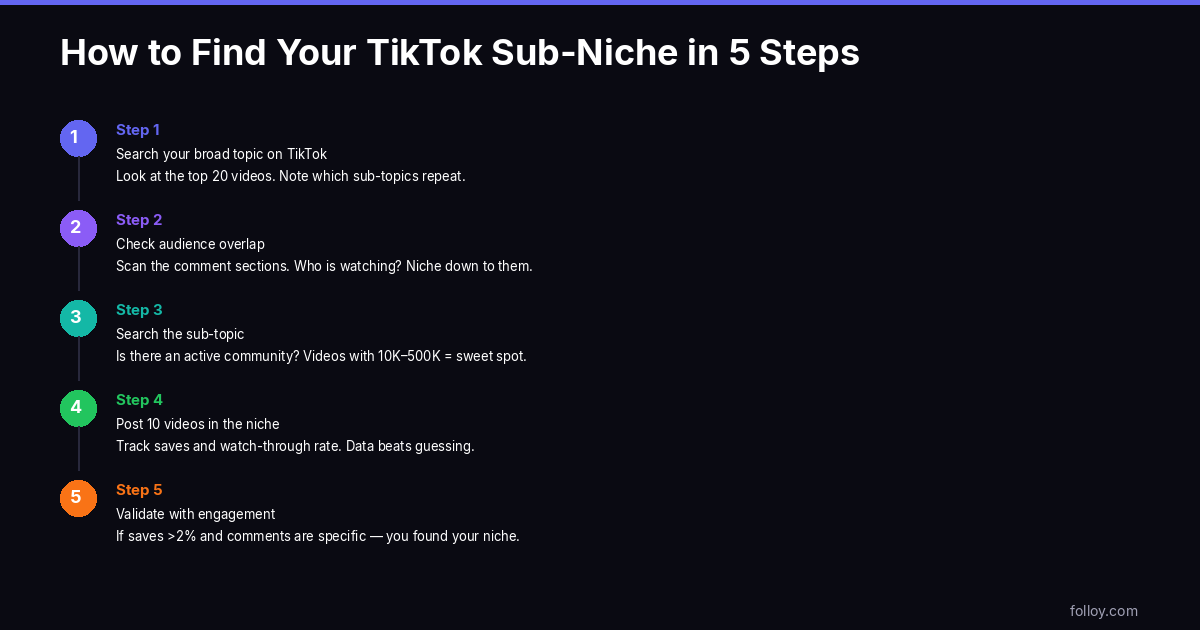
The sub-niche research method: 5 steps to find an underserved lane
Finding a niche that’s both specific enough to build a coherent audience and not so narrow that the audience doesn’t exist requires actual research. Here is the process that works.
- Start in TikTok Creative Center > Hashtag insights. Type your broad category (e.g., “fitness,” “cooking,” “personal finance”). Filter by your target region. Look at the hashtags that have high view counts but mid-level post counts – these indicate audience interest that supply hasn’t fully met yet. A hashtag with 50 million views but only 8,000 posts is a much better signal than one with 500 million views and 400,000 posts.
- Run the hashtag on TikTok search directly. Watch the top 10-15 videos under that hashtag with sound on. What format are they using? What’s the hook structure? What topics within the hashtag are covered vs absent? The gaps in what the top videos cover are your content opportunities.
- Check comment sections on the top-performing videos in your target niche. Comments reveal what the audience wishes the creator had covered, what they’re confused about, and what question they’re asking next. Each of those is a video brief.
- Look at TikTok’s Keyword Insights tool (in Creative Center). Enter topic keywords and look at the search trend data. A keyword that’s growing in search volume but doesn’t have many dedicated accounts creating content around it is an underserved lane.
- Test before committing. Post three videos in the candidate niche before you declare it your niche. Look at the traffic source breakdown (how much comes from For You vs Search vs Followers) and the follow-from-view rate. A niche that generates high follow-from-view (above 0.5% is good for a new account) is confirming that the audience exists and wants more of what you’re making.
What to do when your niche is too small
A niche can be too narrow in two distinct ways. Distinguishing between them determines the fix.
Signs the niche is genuinely underserved but viable
The views are low but the engagement rate is high. Comments are from a passionate, specific audience who ask follow-up questions. Your follower growth is slow but steady and almost entirely from the target demographic. The problem here is not the niche – it is distribution. Your videos haven’t reached the full pool of people who want this content yet. In this case: post more consistently, use the highest-search hashtags within the niche, and collaborate with larger accounts in adjacent niches to cross-pollinate audience.
Signs the niche is actually dead (or dying)
The views are low, the engagement rate is also low, and the few comments you get are from general viewers who stumbled in rather than core enthusiasts. Growth has been flat for 8+ weeks despite consistent posting. Related hashtags show declining trend lines in Creative Center. In this case: you are not in a viable niche. The adjustment is to move one level up in specificity – broader by one step – and look for a sub-niche within that larger category that is still active.
A useful signal to check: look at how many other creators are actively posting in your niche (recent posts, not just historical content). If the most recent videos under your niche hashtag are 3-4 weeks old and have low engagement, that is a meaningful sign of a dead lane. If there are creators posting every day with solid watch-time numbers, the niche is alive and your issue is content quality or discovery, not audience size.
The sub-niche research method: pivoting an existing account without losing everything
If you have an established account that’s too broad, the instinct is to either start fresh or dramatically change overnight. Both tend to backfire. Starting fresh loses the platform authority your account has built. Changing overnight confuses your existing audience and tanks your immediate analytics, which the algorithm interprets as declining quality.
The transition method that works with the least disruption:
- Identify your highest-performing 20% of content. What niche does it cluster around? This is almost always narrower than you think your account is about.
- Shift gradually over 10-15 videos. Do not announce a rebrand. Just start posting more of the niche content that performs and less of the broad content that doesn’t. The algorithm adjusts faster than your audience notices the shift.
- Use the first few videos in the new lane to test content structure, not just topic. Changing niche while also changing your format (from talking-head to tutorial, for example) makes it hard to isolate what’s working. Keep format constant while shifting topic focus.
- Monitor the Followers tab, not just impressions. When the pivot is working, you’ll see your follower demographic shift toward the target audience of your new niche. When it’s not working, you’ll see your existing followers stop watching (high views from Following source, low For You) which signals the algorithm is retreating to serving existing followers rather than expanding reach.
- Give it 6-8 weeks before evaluating. The algorithm takes time to re-classify an account. Pivots that fail at week 3 often would have succeeded at week 7 if the creator hadn’t abandoned the direction.
Getting early views on your pivot content helps the algorithm re-classify the account faster. Some creators use free TikTok views on their first few niche-pivot videos to push them out of zero-data territory and into the algorithm’s active test pools. The goal is to get enough real engagement data so the classifier can assign the new content to the right audience segment. Separately, building your follower base in the target niche matters – free TikTok followers in the early stages of a pivot can help anchor your account’s audience signal toward the new direction.
Niche examples by category: narrow versions that grew fast
These are real niche-to-sub-niche pairs where the narrowing produced significantly faster growth than the broad version. The names are category examples, not specific accounts.
Niche vs sub-niche examples
| Broad niche (too wide) | Sub-niche (right-sized) | Why it works |
|---|---|---|
| Fitness | Strength training for women over 35 | Specific audience with shared pain points and underserved by mainstream fitness content |
| Cooking | Budget Filipino home cooking under $5 per serving | Geo-cultural specificity with passionate diasporic audience in US, UK, Canada, Australia |
| Travel | Budget Eastern Europe travel for solo travellers | Underserved niche; travel algorithms reward specificity over “travel vlog” generalism |
| Personal finance | First-time buyer mortgages in the UK | High commercial intent; specific country = cleaner algorithm targeting |
| Gaming | Retro JRPG speedruns (SNES / PS1 era) | Ultra-passionate niche with no TikTok-native major creator yet |
| Productivity | ADHD productivity systems for remote workers | Large unserved audience; search-driven and shareable |
| Parenting | Toddler tantrum de-escalation techniques | High urgency topic; parents share “send this to my partner” content constantly |
| Fashion | Plus-size thrift flipping and reselling | Combines body-positive trend with practical value; strong save-and-share rate |
- Fitness > powerlifting for women over 35. The broad fitness category is hyper-saturated. Women over 35 who powerlift are a passionate, underserved sub-niche with specific needs (hormonal considerations, injury prevention, programming for strength vs aesthetics) that generic fitness content ignores.
- Cooking > budget Filipino home cooking. Filipino cuisine is a distinct niche, but “budget Filipino cooking with local prices” is specific enough to build a deeply loyal Philippine audience that broad “Asian recipes” accounts don’t reach.
- Travel > solo travel in Eastern Europe on $40/day. Travel is one of the most saturated content categories. Budget solo travel in a specific region with a specific daily limit gives the algorithm something precise to match and gives viewers a clear reason to follow.
- Finance > UK first-time buyers navigating Help to Buy alternatives. First-home buyer content is a huge category. UK-specific + post-Help-to-Buy scheme changes narrowed it to an audience with a very specific problem and high motivation to follow for answers.
- Gaming > retro JRPG deep dives (SNES era). Gaming TikTok is enormous. SNES-era JRPGs attract a specific nostalgic demographic who will watch 10-minute analysis videos to the end – a completion rate profile that mainstream gaming content rarely achieves.
- Productivity > productivity systems for ADHD adults. Generic productivity content ignores the fact that most systems don’t work for neurodivergent people. ADHD-specific productivity has built multiple 100K+ accounts because the audience’s problem is urgent and specific.
- Parenting > gentle parenting for toddler tantrums specifically. Parenting is a massive content category. The tantrum sub-niche works because it’s a specific, recurring pain point with high search intent and emotional urgency – parents watch a “how to handle this exact thing” video completely.
- Fashion > thrift flipping for plus sizes. Thrift flipping is established, but plus-size thrift content addresses a community that mainstream thrifting accounts often ignore, with a loyal audience that converts disproportionately on relevant affiliate content.
Is your niche working? diagnostic table
| Metric | Healthy signal | Warning signal | Action |
|---|---|---|---|
| Watch-time ratio | Above 60% average | Below 40% consistently | Change hook style, not niche |
| Follow-from-view rate | Above 0.5% per video | Below 0.2% consistently | Tighten niche; clarify profile bio |
| Comment quality | Specific, niche-relevant comments | Emoji-only or zero comments | Ask a specific question in every video |
| Hashtag reach | At least 1 niche hashtag drives 5%+ of reach | All reach from FYP, none from hashtags | Test 3 new niche-specific hashtags |
| Competitor performance | Others in your niche are growing | No accounts in your niche have over 5K followers | Niche may be dead — shift to adjacent topic |
What happens after you grow
Once you have a large, well-defined audience, you can broaden gradually. Established creators with 200K-plus followers in a tight niche can drift into adjacent territory because their audience now trusts them as a creator, not just as a topic source. The classifier also gives high-engagement accounts more rope. Niching down is a phase, not a permanent constraint. You narrow to grow, then you can widen to stay interesting.
The bottom line
If your TikTok account has been stuck below 5,000 followers for months and your videos are honestly all over the place, the answer is almost never “post more often.” It is “post about fewer things.” Pick the lane that your best three videos already pointed at. Commit ten videos to it. Then read the data and decide. Niching down feels like giving something up. In practice it is the only way to get the algorithm to send you the audience you were trying to reach all along.
Frequently asked questions
How narrow is too narrow for a TikTok niche?
If the top hashtag in your niche has under 5 million total views and you can count the active creators on one hand, it may be too narrow. The practical test is: post 5 videos in the niche and check if your For You traffic percentage is above 50%. If the algorithm is pushing to For You, the audience pool exists. If it’s pushing mainly to your existing followers, the niche audience on TikTok may be too small to generate organic reach.
Can I run two separate niches on one TikTok account?
You can, but the algorithm will penalize you for it. TikTok’s classifier builds a single audience profile per account. Splitting your content between two unrelated niches means neither audience is served consistently, and the algorithm assigns you a lower confidence score for both. The better approach is separate accounts if both niches are strategically important to you.
How long does it take for the algorithm to recognize my niche after I switch?
Typically 4-6 weeks of consistent posting in the new direction. The algorithm re-classifies accounts based on the pattern of recent posts – usually the last 15-20 videos weighted most heavily. Posting daily in the new niche accelerates the re-classification. Mixing old content back in slows it down or reverses the progress.
Does my TikTok niche need to match my Instagram or YouTube niche?
Not necessarily, but it makes cross-promotion easier. Creators who build a coherent brand across platforms benefit from algorithm cross-pollination: TikTok audiences discover their YouTube, and vice versa. If you’re running different niches on different platforms deliberately, keep them separated enough that the audiences don’t confuse your identity when they cross platforms.
What’s the difference between a niche and a sub-niche?
A niche is a content category: personal finance, cooking, fitness. A sub-niche is a specific angle within that category defined by audience (women over 35), geography (Southeast Asia), constraint (under $50/week), or problem (debt payoff vs investing). Most successful accounts operate at the sub-niche level – specific enough that the right audience self-selects, broad enough that there’s enough content to make consistently.
Should I pick a niche based on what I’m passionate about or what has algorithmic opportunity?
Both matter but the weighting depends on your goal. If growth speed is the priority, identify niches with high demand and low creator supply first, then find the overlap with your genuine interests or expertise. Passion alone in a saturated niche produces content that is personally meaningful but often algorithmically invisible. Opportunity alone in a niche you find boring produces inconsistency, which the algorithm punishes. The sustainable combination is a niche you can talk about credibly and consistently that happens to have unmet demand.
What readers are saying
Real reactions from creators in the Folloy community.
Painfully accurate. I was the “broad creator” for a year — a bit of everything, 600 followers. Picked one specific lane in January and i’m at 14k now. The algorithm genuinely could not figure out who to show my stuff to before.
the “confused algorithm” explanation is the clearest version of this i’ve seen. everyone says niche down but nobody explains WHY it works mechanically. this did.
ok but what if you genuinely have two passions, do you really have to abandon one? struggling with this.
Great question, Sean — the usual answer is one account per lane, or pick the one with more audience demand first and add the second once it’s established. Splitting attention early is what stalls most dual-niche accounts.
i run two accounts for exactly this reason and it works way better than mixing them. bit more effort but worth it.